Most EU citizens don’t want the GM (genetic modified) corn, but the European Commission (EC) and a few bigger states' politicians do, following some bizarre procedure called "comitology" and a German abstention, the EC power is forcing a genetically engineered maize into Europe’s agriculture.
Despite 19 of the EU’s 28 members voted against, the pro-GM Tonio Borg (European Commissioner for Health), claims that under a procedure known as "comitology" http://en.m.wikipedia.org/wiki/Comitology, the EC shall approve the maize. (The content of this link has completed been changed in a very short time, indicating EC government employees working full-time to alter the contents of wikipedia and don't like people to know what is comitology, initially the link is http://en.m.wikipedia.org/wiki/Comitology, it explains just the EC committee's strange and undemocratic ways of passing laws, without mentioning maize approval at all, but the initial text has disappeared in no time)
“If there is no negative qualified majority against the proposal then the Commission not may, but shall, adopt the proposal,” said Tonio Borg. Read http://www.euronews.com/2014/02/11/gmo-corn-from-du-pont-dow-gets-green-light-in-europe/
UK, Spain. Finland, Estonia and Sweden voted in favour, while Belgium, Portugal and the Czech Republic abstained. But the critical abstention was the big vote carrying Germany. For some unknown reason, each vote did not carry the same weight, which cleared the way for the approval.
Read more details from http://www.gmeducation.org/government-and-corporations/p217267-will-a-bizarre-vote-finally-let-gmo-maize-into-europe.html
If 19 out of 28 is not a majority, I don't know what is?!
The European Parliament has long had a problem with the lack of transparency of comitology committees, stemming mainly from the fact that Members of the European Parliament (MEPs) are excluded from the comitology process. A broader concern has been voiced about the public accountability of comitology. As sites of European governance which produce a vast amount of binding legislation, comitology's opaque mode of operation, unclear membership, and closed debate style has been the subject of criticism from academics for years.
When the majority of EU citizens don't want it, but the greed of those GM corporations is winning each battle, what's the use of going to the poll to vote for our EU parliament members if the EC can find some loopholes and impose regulations against citizens' wish? Democracy is dead in Europe!
We need a EU referendum on GM seeds if politicians only bow their heads to GM giants against people's will.
Health is a universal issue, if you are not a citizen of EU (say if you live in my home country, Taiwan), you should still read on because Taiwan often bases its regulations and testing standards on US.
The US has the revolving door problem i.e. former GM industry employees taking up FDA (Food and Drug Adm) posts to serve the commercial interests of the GM corporations instead of regulating to safeguard public health. Click the first red section titled "Monsanto's Government Ties" on opening the link below http://www.organicconsumers.org/monsanto/news.cfm
EU should block its revolving door problem http://www.alter-eu.org/revolving-doors/block-the-revolving-door because too many EU officials were former lobbyists and will work again in lobbying once they finish their terms in the public sector. Over half of the 209 scientists sitting on the European Food Safety Authority (EFSA) agency's panels have direct or indirect ties with the industries they are meant to regulate. http://corporateeurope.org/efsa/2013/10/unhappy-meal-european-food-safety-authoritys-independence-problem
Proposal that individual EU country can ban GM crop is just a trap
"A new strategy on GM issues" - a report by the Brussels biotech lobby group EuropaBio (the name sounds like pro-organic but it is actually a pro-GM lobbying firm) concluded that a new approach is needed to break the standstill on GM crops in Europe. This includes an "amended nationalisation proposal" putting as a condition that member states can only apply for a national ban if they have first asked the company to refrain from marketing the GM crop in their country, and if the company has refused. Read Biotech lobby's fingerprints over new EU proposal to allow national GMO bans http://corporateeurope.org/food-and-agriculture/2014/05/biotech-lobbys-fingerprints-over-new-eu-proposal-allow-national-gmo
Wind, birds, honey bees can carry GM seeds and cross-pollinate with natural seeds, thereby destroying the existing export credential of farmers who grow conventional seeds and always work hard to remove weeds without chemical sprays. Wind, birds, and bees travel regardless of national borders, so if one country in EU says yes to GM seed, the neighboring country will be contaminated soon despite saying no. Besides, with the entrance of GM seeds, more pesticide will be sprayed in European farms.
Unless the no-to-GM countries can seek monetary compensation for the contamination of GM seeds and of pesticide into their fields from those countries that say yes-to-GM, otherwise, it will be unfair to the majority of countries that had voted no.
Some US conventional seed farmers have experienced rejects by importing countries because their products have been tested to be GM contaminated, losing their exporting potential, and increasing their costs of pre-exporting analytical tests to ensure products are free from GM contamination, the US conventional farmers are in courts fighting for their rights against the GM industry. Example, Japan Rejects Import Of U.S. Wheat: Polluted With GMOs http://www.collective-evolution.com/2013/05/31/japan-rejects-import-of-u-s-wheat-polluted-with-gmos/ and Organic Farmers vs. Monsanto: Final Appeal to U.S. Supreme Court to Protect Crops from GMO Contamination http://ecowatch.com/2013/12/24/farmers-monsanto-gmo-contamination/
Chronology of the US conventional farmers' wars against Monsanto http://www.osgata.org/osgata-et-al-v-monsanto/
Allowing the initial testing of GM seeds to grow outside of a controlled environment (and all the time in undisclosed secret locations), allowing GM seed patenting - thus enabling GM corporations to control seeds and expand quickly to monopolize the seed markets (replacing conventional seeds with GM seeds leaving US farmers without a choice) while not carrying out independent longer-term studies of health effects of eating GM food, plus purposely disallowing clear food labeling (in favor of GM industry and against consumers' wish) are the biggest mistakes of the US authorities.
Although (most of) Europe does not grow GM corns, Spain does, and many animals are fed with imported GM corns too. I checked the Corn Flakes box and it is produced in Spain, so I will stop buying it as I don't have confidence that I am feeding my children healthy food. I also prefer local meat products.
The GM seeds have already contaminated the soil of farmers who grow conventional seeds around the globe (but mostly in US), in US 90% of corns are genetically modified, but recently their corns got sick easily, they started to realize the importance of seed diversity.
"No one is certain why Goss’s wilt has become so rampant in recent years. But many plant pathologists suspect that the biggest factor is the hybrids chosen for genetic modification by major seed companies like Monsanto, DuPont and Syngenta."
"My theory is that there were a couple of hybrids planted that were selected because they had extremely high yield potentials," said Dr. Robertson, whose research is financed by Monsanto and the Agriculture Department.
"They also may have been highly susceptible to Goss’s wilt."
Read the entire article Is Lack of Genetic Diversity and Crop Diversity Accelerating a New Epidemic in Corn http://www.seedmatters.org/is-lack-of-genetic-diversity-and-crop-diversity-accelerating-a-new-epidemic-in-corn/
With the US devastated by the recent corn disease, if the EU follows the same path and has the similar problem in future, that will be the beginning of the worldwide shortage of food and animal feed crisis.
Ecological farming is the better way to farm while keeping our environment free from toxic chemicals. Read one example of eco farming in Vietnam http://www.gmeducation.org/government-and-corporations/p217582-no-gmos-and-no-pesticides:-vietnamese-farmers-use-flowers-to-protect-rice.html
What are the GM corns?
They are corn varieties resistant to glyphosate herbicides and the first variety was commercialized in 1996 by Monsanto, known as MON 810 - Roundup Ready Corn.
Roundup (glyphosate) is a weedkiller sold by Monsanto, by using the Roundup Ready Corn (MON 810), farmers can spray the entire field using Roundup to kill the weed but not the corn. Since the MON 810 corn is genetically modified to resist Roundup, farmers spray pesticide when weeds come out while the corns adjacent to weeds are "eating" just as much pesticide. This way, Monsanto has profited from selling both the Roundup weedkiller and the patented GM MON 810 corn seed.
Often the food and drug regulatory authorities approve new products base only on the (misleading) info provided by the GM industry without other independent studies by research groups unrelated to or not sponsored by the GM companies.
An independent study by the Séralini research team found that beyond 90 days of consuming the GM corn, rats have developed tumors.
Unfortunately not just democracy is dead in EU, scientific advancement and academic freedom are hindered by GM industry's greed.
In May 2013, six months after the Séralini study release, Elsevier (note: the publisher for FCT, Food and Chemical Toxicology) announced that it had created a new position, “Associate Editor for Biotechnology.” The person they hired to fill it was Richard E. Goodman, a former Monsanto employee who in addition was with the Monsanto pro-GMO lobby organization, the International Life Sciences Institute (ILSI) which develops industry-friendly risk assessment methods for GM foods and chemical food contaminants and inserts them into government regulations.
As one critical scientific website posed the obvious ethical sham of hiring Monsanto people to control GMO publications, “Does Monsanto now effectively decide which papers on biotechnology are published in FCT? And is this part of an attempt by Monsanto and the life science industry to seize control of science?"
Then on November 24, 2013, six months after Goodman took control of GMO issues at the Journal, Dr A. Wallace Hayes, the editor of the journal Food and Chemical Toxicology decided to retract the study by the team of Professor Séralini. (threatened to lose his job?)
Read details of Séralini research and retraction of publication controversy http://www.globalresearch.ca/the-toxic-impacts-of-gmo-maize-scientific-journal-bows-to-monsanto-retracts-anti-monsanto-study/5360394
Séralini’s team studied the effect of a Monsanto GMO maize diet on the rats for much longer than Monsanto had in their study submitted to the EU European Food Safety Authority for approval. They did their study for the full two year average life-time instead of just 90 days in the Monsanto study. The long time span proved critical. The first tumors only appeared 4 to 7 months into the study. In industry’s earlier 90-day study on the same GMO maize Monsanto NK603, signs of toxicity were seen, but were dismissed as “not biologically meaningful” by industry and EFSA alike. More details about the experiment and the corrupted EFSA officials see this http://www.globalresearch.ca/stench-of-eu-corruption-in-monsanto-gmo-whitewash/5316294
Monsanto’s analysis compared unrelated feeding groups, muddying the results. The June 2009 rebuttal explains, "In order to isolate the effect of the GM transformation process from other variables, it is only valid to compare the GMO…with its isogenic non-GM equivalent."
The (Séralini) researchers conclude from all three GMO studies that novel pesticide residues will be present in food and feed and may pose grave health risks to those consuming them. They have called for "an immediate ban on the import and cultivation of these GMOs and strongly recommend additional long-term (up to two years) and multi-generational animal feeding studies on at least three species to provide true scientifically valid data on the acute and chronic toxic effects of GM crops, feed and foods." Read Three Approved GMOs Linked to Organ Damage by Rady Ananda http://zcomm.org/zmagazine/three-approved-gmos-linked-to-organ-damage-by-rady-ananda/
Not only eating the GM corn may cause health problem, the Roundup weedkiller was a health risk - used in gardens, farms, and parks around the world, Roundup contains an ingredient that can suffocate human cells in a laboratory, researchers say on Jun 23, 2009. Read Weed-Whacking Herbicide Proves Deadly to Human Cells http://www.scientificamerican.com/article/weed-whacking-herbicide-p/
A Canadian study shows GM DNA can cross the placental barrier. They said it would never happen.
http://www.gmeducation.org/briefings/p149281-genetically-modified-dna-found-in-foetal-blood.html
Real scientific research should be one that quest for new knowledge, not one that covers up negative findings to serve the commercial interests of a special group.
The FDA researchers were fired, threatened, or relocated to other jobs when they wanted to do their job right.
The example below is related to the testing of milk safety with cows being injected with artificial hormone:
Veterinarian Richard Burroughs, who had a lead role in the review process, was shocked at how few tests the agency was requiring. Burroughs ordered more tests, but was soon fired. He said, “I was told that I was slowing down the approval process.” Burroughs says that the science in the studies was well outside the expertise of FDA employees, but officials “suppressed and manipulated data to cover up their own ignorance and incompetence.” Alexander Apostolou, director of the FDA's Division of Toxicology, says, “Sound scientific procedures for evaluating human food safety of veterinary drugs have been disregarded.” When he expressed his concerns at the agency, he was pressured to leave.” Chemist Joseph Settepani testified at a public hearing about “a systematic human food-safety breakdown at the Center for Veterinary Medicine.” Prior to his testimony, he was in charge of quality control for veterinary drug approvals. Soon after, he was stripped of his duties as a supervisor and sent to work in a trailer at an experimental farm.
GM industry tried to bribe Canadian researchers into approval
While Monsanto's tactics have been fairly effective in the United States, they have tried equally hard north of the border. In 1998, six Canadian government scientists testified that they were being pressured by superiors to approve rbGH. The six were employed by Health Canada — the Canadian equivalent of the US FDA. Their job was to determine if the milk from treated cows was safe to drink. They didn't think so. In fact, they had compiled a detailed critique of the FDA's evaluation of rbGH, showing that the US approval process was flawed and superficial. However, senior Canadian officials and Monsanto tried to force the Canadians to approve it anyway.
According to the Toronto Globe and Mail (note: The Globe and Mail is a national paper circulated in Canada not just a Toronto local paper), “The scientists' testimony before a Senate committee was like a scene from the conspiratorial television show 'The X-Files.'” They told the senators that government scientists “often feel that their careers are threatened if they stand in the way of a drug they don't believe is safe,” and “managers without scientific experience regularly overrule their decisions.”
Dr. Margaret Haydon said that when she refused to approve rbGH due to her concerns for human health, she was taken off the study. The Ottawa Citizen reported that Haydon “recounted how notes and files critical of scientific data provided by Monsanto were stolen from a locked filing cabinet in her office,” and that she “told of being in a meeting when officials from Monsanto...made an offer of between $1 million and $2 million to the scientists from Health Canada — an offer that she told the senators could only have been interpreted as a bribe.” Read details from A Short History of Genetically Engineered Bovine Growth Hormone by Jeffrey Smith http://www.councilforresponsiblegenetics.org/ViewPage.aspx?pageId=125
What European parliament needs to do without delay is to start an investigation into the corrupted EC officials and to stop the revolving door - enact a law that will effectively prohibit conflict of interest appointments.
And the UN should enact clear food labeling law for world trade, and prohibit seed patenting as it is against the nature. Besides, GM seeds should not be allowed to contaminate the crops of disadvantaged nations by means of so called "foreign aids" because of disaster or famine, receiving ends should have a choice - advised if the "aids" contain GM crops.
A clear labeling law means for processed food the label should include ingredients' percentage followed by the country code, followed by a GM indicator. If for a specific ingredient, it has a mixture coming from 2 different countries, immediate following the ingredient percentage, the first country code be written for the major supplier of the ingredient and the second country code followed since it is the secondary supplier, all ingredients must be clearly labeled with a GM indicator.
After all, if the GM food is so great as promoted by the GM industry, why it isn't in the menu at the cafeteria of Monsanto's facility?
Read Monsanto' canteen in UK does not serve GM food
http://www.greenpeace.org/seasia/ph/News/greenpeace-philippine-blog/eat-it-up-monsanto/blog/39039/
The GM food should not just stop at the EU border, it should be wiped out from our globe regardless of border. We should start to revert back to green revolution, repecting the natural ecological system.
Related links:
You must read this: Continuing the Green Revolution:
The corporate assault on the security of the global food supply http://www.mit.edu/~thistle/v13/4/food.html
Who grows what in GM seeds
http://www.genewatch.org/sub-532326
or another good source at the GM approval data base from the organization servicing the interests of the GM corporations http://www.isaaa.org/gmapprovaldatabase/default.asp
Revealed how seed market is controlled by Monsanto, Syngenta, Bayer, Dow & DuPont http://www.theecologist.org/News/news_round_up/625294/revealed_how_seed_market_is_controlled_by_monsanto_syngenta_bayer_dow_dupont.html
The video of the Séralini research team from the left-side of this page http://www.gmeducation.org
Scientists' hidden links to the GM food giants: Disturbing truth behind official report that said UK should forge on with Frankenfoods http://www.dailymail.co.uk/news/article-2581387/Scientists-hidden-links-GM-food-giants-Disturbing-truth-official-report-said-UK-forge-Frankenfoods.html
Showing posts with label EU 歐盟. Show all posts
Showing posts with label EU 歐盟. Show all posts
Wednesday, June 4, 2014


Friday, July 27, 2012
A summary of this week’s news on Euro currency
The euro crisis has returned to haunt politicians and economists this week
with Greece potentially facing bankruptcy, Spain getting closer to a bailout,
and Germany risking its top credit rating.
With prolonged economic weakness and spillover for the currency
bloc, Greece will, with 90% chance as predicted by the Citigroup Inc., leave the euro zone in the next 12 to 18 months. Read
the detailed news in this link: http://www.bloomberg.com/news/2012-07-25/citigroup-sees-90-chance-that-greece-leaves-euro.html
Ifo
Institute for Economic Research has estimated that if Greece become insolvent and quits the euro
zone, Germany should expect a loss of up to 82 billion euros, while if an
insolvent Greece remains within the single currency bloc it would cost Berlin
89 billion euros. Read the detailed news in
this link and pay special attention to the paragraph at the end: http://www.reuters.com/article/2012/07/25/us-germany-economists-euro-idUSBRE86O0FA20120725
So, it follows logically that German politicians will try to steer euro zone policies towards the direction which would minimize its country's loss.
After studying the Ifo report, German
Economy Minister Philipp Rösler has drawn his conclusion - Greek exit from the
euro had "lost its horrors" - making such a comment during his interview with ARD TV on Sunday. Some senior members
in Germany's ruling coalition also agreed with him. http://www.spiegel.de/international/europe/german-economy-minister-roesler-criticized-for-comments-about-greece-a-846110.html
On Monday, the
day after Rösler’s comment,
the financial market reacted to the uncertainty of the currency - the euro fell
to its lowest level against the dollar in more than 2 years.
The Domino
effect of credit ratings
Also on
Monday, the Credit ratings agency Moody's slashed its
outlook for the creditworthiness of not only Germany, but also of the
Netherlands and Luxembourg to "negative" from "stable."
Though Moody's maintained its triple-A ratings for all three countries, it said the increasingly uncertain outlook stemming from the European debt crisis was behind the changes. Read detailed news from this link. http://www.spiegel.de/international/germany/german-press-on-moody-s-cut-to-german-credit-outlook-a-846322.html
A group of economists are calling for a radical restructuring of Europe and the euro zone to prevent a disaster of incalculable proportions. Read “Economists Warn EU on Threshold of Catastrophe" http://www.spiegel.de/international/europe/debt-crisis-economists-warn-of-euro-catastrophe-a-846327.html
NY-based
Institute for new economic thinking, INET, on July 23 2012 released a report
stating that politicians need to move decisively and timely to save the euro
currency or else it could disintegrate.
Read the report “Breaking the deadlock: a path out of the crisis”
http://ineteconomics.org/sites/inet.civicactions.net/files/INET%20Council%20on%20the%20Euro%20Zone%20Crisis%20-%2023-7-12.pdf
Europe, with many different languages and the unforgettable history of wars among them, although the Eurovision has members extending to Asia, it is skeptical that Europe has a united vision.
Without a political union, the monetary union doesn't seem to work.
Meanwhile, in Greece people will continue to cope with austerity measures with bartering, euro money has no use here when people have very little income.
Other
links:
You may also be
interested in this previous post.
Derivatives and public debt management by
Gustavo Piga
Saturday, July 7, 2012
Corporate financial greed and Greek economic crisis
Most of us
have been taught by our parents that taking advantages of someone’s misfortune
is simply unethical.
When a country
was hit by an earth quake or tsunami, other countries will pour in humanitarian
help and the UN will provide some relief aids.
But when a
country is hit by economic crisis, vulture funds are more rampant and the UN does
not do anything (such as starting a discussion group). Indeed the UN is a non-performing (of its
mission) organization in the world of “un-united nations”.
Before you
call the Greeks lazy, you should read the articles below, and tell me if the
guys who sit and do nothing and just buy vulture funds are lazier. Greek economic crisis has many causes, but
the following causes are less known yet exacerbated the situations and need to
be mentioned more by people with conscience in the blogosphere.
What are Vulture
Funds?
The term Vulture Fund refers to a company that seeks to
profit by buying up debt in default on the secondary market for pennies on the
dollar, then trying to recover up to ten times the purchase price, often by
suing in U.S. or European courts.
While some Vulture Funds target failing companies, others go
after the sovereign debts of impoverished countries, significantly undermining
the intended impact of debt relief. These companies operate with little
transparency. As shell companies (a company set up exclusively to pursue one
goal, in this case, poor country debt), Vulture Funds are established in tax
havens like the British Virgin Islands to avoid financial constraints and
oversight. Because of the secretive incorporation strategies and locales, there
is limited or no information on who actually owns and manages these Vulture
Funds.
Low-income
countries that are eligible for debt cancellation are especially vulnerable.
Vulture Funds track the debt relief process, buy soon-to-be-relieved debt from
creditors, and then sue the poor country after it has received a windfall of
resources thanks to debt cancellation.
Corporate financial greed
Thanks to Bloomberg, some
transparency has started to surface about Greece’s secret loan from Goldman Sachs Group Inc. (GS) was a
costly mistake from the start.
On the day the
2001 deal was struck, the government owed the bank about 600 million euros
($793 million) more than the 2.8 billion euros it borrowed, said Spyros
Papanicolaou, who took over the country’s debt-management agency in 2005. By
then, the price of the transaction, a derivative that disguised the loan and
that Goldman Sachs persuaded Greece not to test with competitors, had almost
doubled to 5.1 billion euros, he said. Read the detailed article from this link.
When Greece
announced in May that it had made a €436 million bond payment to the hold-out
investors who rejected the country's historic debt revamping deal in March,
almost 90 percent of this payment was delivered to the coffers of Dart
Management, a secretive investment fund based in the Cayman Islands, according
to people with direct knowledge of the transaction. Dart is one of the best known of the
so-called vulture funds, which have a track record of buying the distressed
bonds of nearly bankrupt countries — and if they do not get paid, suing the
governments for the money. Read the detailed article on this link.
How can a country get rid of debt when these vulture
funds work against the initial intend of bailouts?
Other interesting links:
For Germans who read only the Bild and supported its POV
on the Open Letter to Greek Voters, a news for you to realize that even a German
company, Hochtief, likes to avoid paying taxes too.
End the unethical vulture funds, and a call for Greek debt audit.
Saturday, June 16, 2012
Greek Election 2012 - photos related to current affairs

a statue in downtown Athens

a close-up of the same statue shows the Greek words (with my translation): Greece wants to live, and it will
I hops so, but unless the Greek politicians cooperate and set aside their differences, plus the parliament "cleans its house", it may become like the old Greece shortly after the Second World War.
If I were a Troika official, this will be one of my negotiation demands: that the newly-elected Greek MPs from tomorrow's election receive only the minimum wage with no extra benefits what so ever.
The Troika should have scrutined the operating cost of the Greek parliament compared to those of the other European countries.
The Troika was partially responsible for fueling the development of the SYRIZA and other extremist groups because the cut on MPs salaries & benefits is minimal compared to the austerity inflicted upon the most vulnerable people in the society.

a photo of Greek president Karolos Papoulias from my TV during a military parade on March 25 2010, but a military parade on October 28 2011 was cancelled due to a demonstration partly sponsored by SYRIZA.
People should not vent their anger on Papoulias (not a traitor), nor on foreign advisors trying to bailout Greece (not invaders).

Anarchists had drawn graffti all over the city of Athens including on historical buildings

a close-up of the same building shows the Greek words (with my translation): gasoline and fire on each bank
After tomorrow's election, if SYRIZA wins the majority, will the anarchisis still be against the "government" ? Or will Tsipras dispatch SYRIZA party volunteers to clean-up all the anti-government slogans in Athens?

marble pieces were smashed and removed during protests, this is what's left on a peaceful day near Syntagma (the Constitution Square)

a statue of a hero named Kolokotronis during the Greek War of Independence (1821 - 1832) in downtown Athens

a close-up of the same statue with more clear Greek words (with my translation): riot now, the rest is in English: Fxxx heroes, fight now, and the anarchist's symbol - an encircled capital letter A
The original text underneath the graffiti is in ancient Greek, I can only read partially due to my lack of knowledge, and if you can read the whole text, please provide translation in the reader's comment area.
Anarchists in Greece do not just disobey government authority, they are hooligans that destroy their country's economy (as in riots & lootings of commercial streets after demonstrations), as well as tourism industry (who wants to see historical buildings covered with graffiti?)
Greece is a fertile country, poorly managed by its corrupted politicians, and wounded by the self destruction force of its anarchists

vs. a statue in Munich's Marienplatz - no graffiti, how nice for a tourist to shoot

vs. a statue in Munich's Nymphenburg Palace - again no graffiti

sometimes instead of graffiti, the road sign is changed or covered up, here the station name "θησείο" (Thi-si-o) had been altered to "Οησείο" (o-i-si-o)
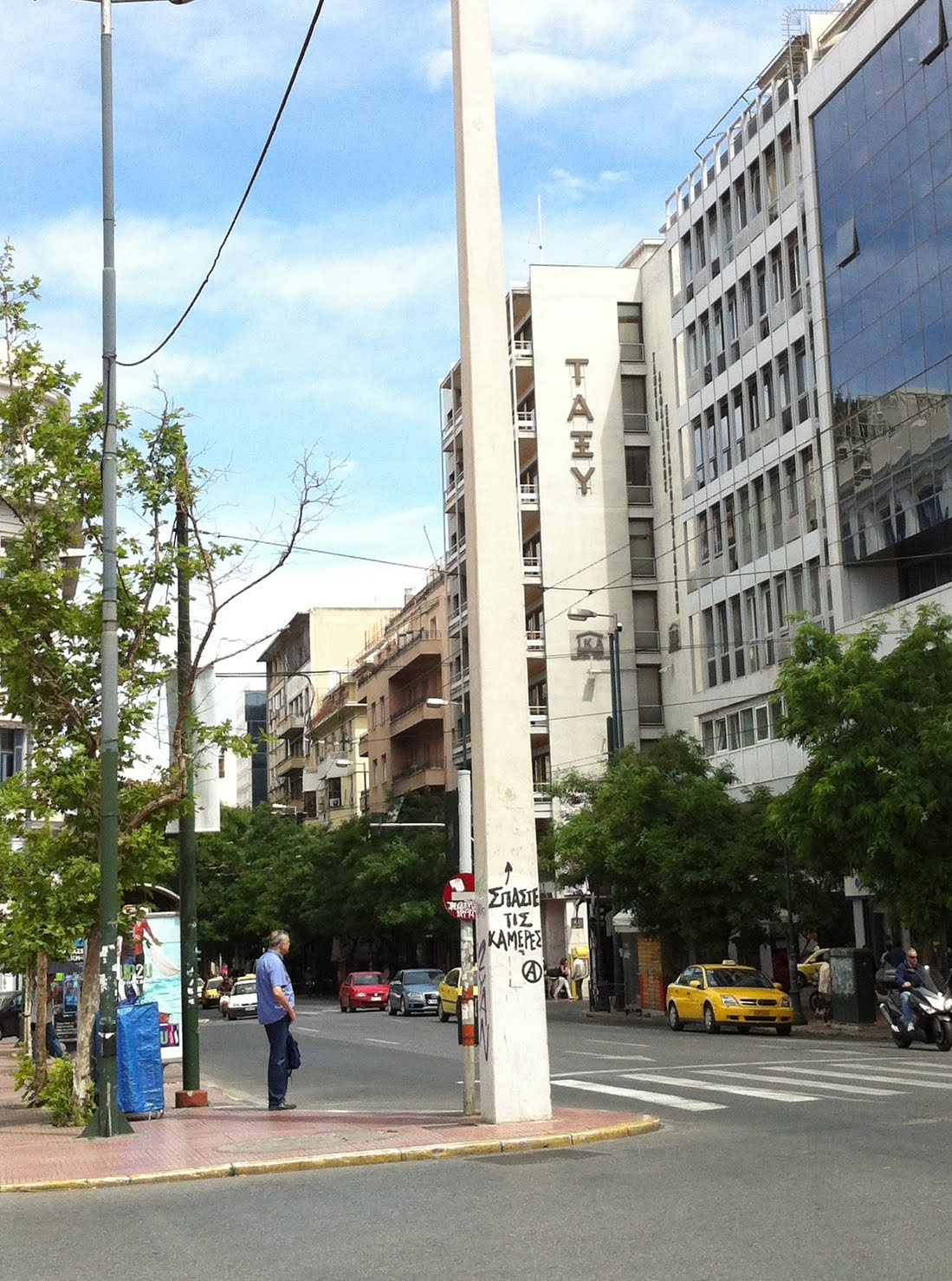
a pole supporting a surveillance camera near downtown's bus terminal with anarchist's writing (with my translation): break the cameras

Τράπεζα της Ελλάδος (Bank of Greece) near Metro station Panepistimio on Eleftheriou Venizelou Street - has no authority to print Euro bills

a statue commemorating the end of using the Greek Drahma - showing a drahma coin (ΔΡΑΧΜΗ)

a close-up of the lower part of the statue with fine print saying (with my translation): Drahma, the oldest currency in Europe stopped (circulation), and replaced by Euro on January 1, 2002

Greek traditional dance being demonstrated during a Greek festival in Munich June 27, 2010

I am happy to see the Greek traditional costume demonstrated at the same event because I haven't had a chance to shoot such a nice traditional dress here in Greece

Greek fast food being served

Greek fast food menu in German
My boy's playmate's father, a US-educated aerospace engineer, has been working in Germany for years, a family involuntarily separated by the reality of lack of work opportunity (and of people connection) here in Greece. When his landlord decided to take his rental apartment for own use recently after many years of living in the same apartment, it took him a long time to locate a new apartment because Greeks are no longer welcome in Germany although he works there and contributes to the German GDP.
When the Olympic Airline privatized a few years ago, his resume for applying for a lower-paying job in Greece (so he can be with his family) had gone unanswered probably due to his lack of connection in Greece.
Whereas a freind of my husband - a computer professor who had earned enough money abroad and had decided to return (about 5+ years ago) to contribute his expertise to teaching his beloved country's students may have started to question his wrong decision.
Other Greeks overseas may feel "no pride being a Greek", or have to conceal his identity for safety reasons.

The people of Greece are pushed to this stage where they have to pick between an experienced party that had participated in this country's most famous national sport - corruption, which was initiated by the PASOK, or an inexperienced SYRIZA who knows nothing about governing, but very experienced in rioting.
Alternatively, the politicians in Greece can set aside their differences and rebuild their bankrupt country through cooperations.
God bless Greece!
Thursday, June 14, 2012
Greek Election – Parliament closure may ease austerity
Reforms are the
keys to Greece’s survival but Greek politicians are too scared of implementing
them. Most people in Greece welcome
reforms carried out by foreign experts with the exception of the privileged
groups of politicians and some public servants.
Does democracy
work in Greece? Greek parliamentarians
are freely elected; therefore, the political system cannot be classified as
undemocratic, but for the past 30 some years many dubious or contradictory laws
have been passed in the Greek parliament.
If Greek citizens think that they
have fulfilled their responsibilities by simply going to the polls, they have
made a big mistake of not having supervised their parliament’s day–to-day operations and after years of un-scrutinization, democracy in this country is in complete failure.
A summary list of
the Greek political salaries and perks exempt from austerity; minimum wage was
agreed to be reduced by 22%, from €751.39 to €586.08 http://digitaljournal.com/article/319313
Greek MPs indeed cost
taxpayers too much money
Double Pensions for
employees of the parliament, and more…
Read the last
paragraph of the above link:
“To write an article for the free edition
Free Sunday the journalist sent a letter requesting information about the
operating costs of the parliament, the cost of salaries and other costs of
deputies, the number of the administrative employees and the costs for their
salaries and about the deputies and employees salaries cutting last year. In
response, they sent him from parliament three press releases from last year
that respond only to the last question.”
The Greek president (whom
I respect) had asked to remove himself from the government’s payroll, but how
about the rest of the Greek politicians?
There is also parliamentarian’s
immunity from criminal charges.
Are there too many parliamentary
seats in the Greek parliament?
Yes, I think there is a
BIG problem of over representation on top of the problem of paying each
parliamentarian’s fat salary and benefits.
The employed people in
Greece have to feed these fat politicians, who have eaten up EU grants for
developing this nation, no wonder many middle-class families are hit by yet
another new income tax – a surtax based on GROSS income (i.e. income before any
deductions, notice this is not surtax based on tax payable like in Canada), and
this is on top of what we had paid for the property tax, and the emergency tax,
and the rising value-added tax on consumer products, and still not enough to
rescue the sovereign debt.
The following is a
comparison of the ratio (population to the number of parliamentary seats) for
some countries in and outside of the European Union, the population statistics
are based on either estimated or census figures for the latest year of a general
election (lower house) of a country (except Greece because I didn’t find the 2012
population figure).
Greek population 2011
census 10,787,690 (and is reducing because people got fed up with the
situations and are leaving the country)
Greek parliamentary
seats 300, i.e. 1 seat per 35,959 persons
German population in 2009
was 82,002,356
Elected German parliamentary
seats 622, i.e. 1 seat per 131,837 persons
France population
in 2007 was 63,645,065
Elected National
Assembly 577 seats, Senate indirectly elected 348 seats, a total of 925 seats,
i.e. 1 seat per 68,805 persons
United Kingdom population
in 2010 was 62,262,000
Elected members of the
House of Commons 650, plus 788 appointed members of the House of Lords, total seats
1438 i.e. 1 seat per 95,788 persons based on elected members or 1 seat per 43,298
persons based on a combined upper and lower chambers (notice that this figure
is still higher than Greece)
Italy population in
2008 was 59,619,290
Elected Chamber of
Deputies 630 seats, plus Senate 322 seats (of which 315 were elected inside
Italy, 6 representing abroad and 1 appointed), a total combined 952 seats, i.e.
1 seat per 62,625 persons
Spain population in
2011 was 46,152,926
Elected Congress of
Deputies 350 seats, Senate 266 seats (208 elected by popular vote, 58 appointed
by regional legislaturs), a total of 616 seats, i.e. 1 seat per 74,924 pesons
Canada population
in 2011 was 34,278,406
Elected members of
parliament 308, but if including non-elected senators the total is 413, i.e. 1
seat per 111,294 persons based on elected members, or 1 seat per 82,999 persons
based on a combined upper and lower chambers
Australia population
in 2010 was 22,342,400
House of Representatives
150 seats, Senate 76 seats of proportional representation, a combined total of
226 seats i.e. 1 seat per 98,860 persons
Portugal population in
2011 was 10,636,979
Elected Assembly of
the Republic 230 seats, i.e. 1 seat per 46,248 persons
Conclusion, Greece has the lowest population to parliamentary seat ratio of the above countries, pointing to the problem of over representation.
Sadly, by closing the
Greek parliament and inviting foreign experts to manage Greek laws and Greek
sovereign debt will make Greece more competitive and will ease some
unfair austerity bills passed by the Greek parliament.
Other interesting links:
Richard Koo’s
prescription for Greece (and Germany)
http://ftalphaville.ft.com/blog/2012/05/30/1022281/richard-koos-prescription-for-greece-and-germany/
Comparing sovereignty
debt charts
Greek poll
results since the last election (scroll further down the link to view a chart)
Dictionary definition
of 'siphon' has been wrong for nearly a century
It is the gravity and
not the difference in atmospheric pressure that makes siphon works as Dr.
Stephen W Hughes clarified.
http://eprints.qut.edu.au/31098/25/A_practical_example_of_a_siphon_at_work_eprint_(2).pdf
Subscribe to:
Posts (Atom)