Search This Blog

Showing posts with label Greek election 希臘選舉. Show all posts

Saturday, June 16, 2012

Greek Election 2012 - photos related to current affairs

a statue in downtown Athens

a close-up of the same statue shows the Greek words (with my translation): Greece wants to live, and it will

I hops so, but unless the Greek politicians cooperate and set aside their differences, plus the parliament "cleans its house", it may become like the old Greece shortly after the Second World War.

If I were a Troika official, this will be one of my negotiation demands: that the newly-elected Greek MPs from tomorrow's election receive only the minimum wage with no extra benefits what so ever.

The Troika should have scrutined the operating cost of the Greek parliament compared to those of the other European countries.

The Troika was partially responsible for fueling the development of the SYRIZA and other extremist groups because the cut on MPs salaries & benefits is minimal compared to the austerity inflicted upon the most vulnerable people in the society.


a photo of Greek president Karolos Papoulias from my TV during a military parade on March 25 2010, but a military parade on October 28 2011 was cancelled due to a demonstration partly sponsored by SYRIZA.

People should not vent their anger on Papoulias (not a traitor), nor on foreign advisors trying to bailout Greece (not invaders).

Anarchists had drawn graffti all over the city of Athens including on historical buildings

a close-up of the same building shows the Greek words (with my translation): gasoline and fire on each bank

After tomorrow's election, if SYRIZA wins the majority, will the anarchisis still be against the "government" ? Or will Tsipras dispatch SYRIZA party volunteers to clean-up all the anti-government slogans in Athens?


marble pieces were smashed and removed during protests, this is what's left on a peaceful day near Syntagma (the Constitution Square)

a statue of a hero named Kolokotronis during the Greek War of Independence (1821 - 1832) in downtown Athens

a close-up of the same statue with more clear Greek words (with my translation): riot now, the rest is in English: Fxxx heroes, fight now, and the anarchist's symbol - an encircled capital letter A

The original text underneath the graffiti is in ancient Greek, I can only read partially due to my lack of knowledge, and if you can read the whole text, please provide translation in the reader's comment area.

Anarchists in Greece do not just disobey government authority, they are hooligans that destroy their country's economy (as in riots & lootings of commercial streets after demonstrations), as well as tourism industry (who wants to see historical buildings covered with graffiti?)

Greece is a fertile country, poorly managed by its corrupted politicians, and wounded by the self destruction force of its anarchists

vs. a statue in Munich's Marienplatz - no graffiti, how nice for a tourist to shoot

vs. a statue in Munich's Nymphenburg Palace - again no graffiti

sometimes instead of graffiti, the road sign is changed or covered up, here the station name "θησείο" (Thi-si-o) had been altered to "Οησείο" (o-i-si-o)
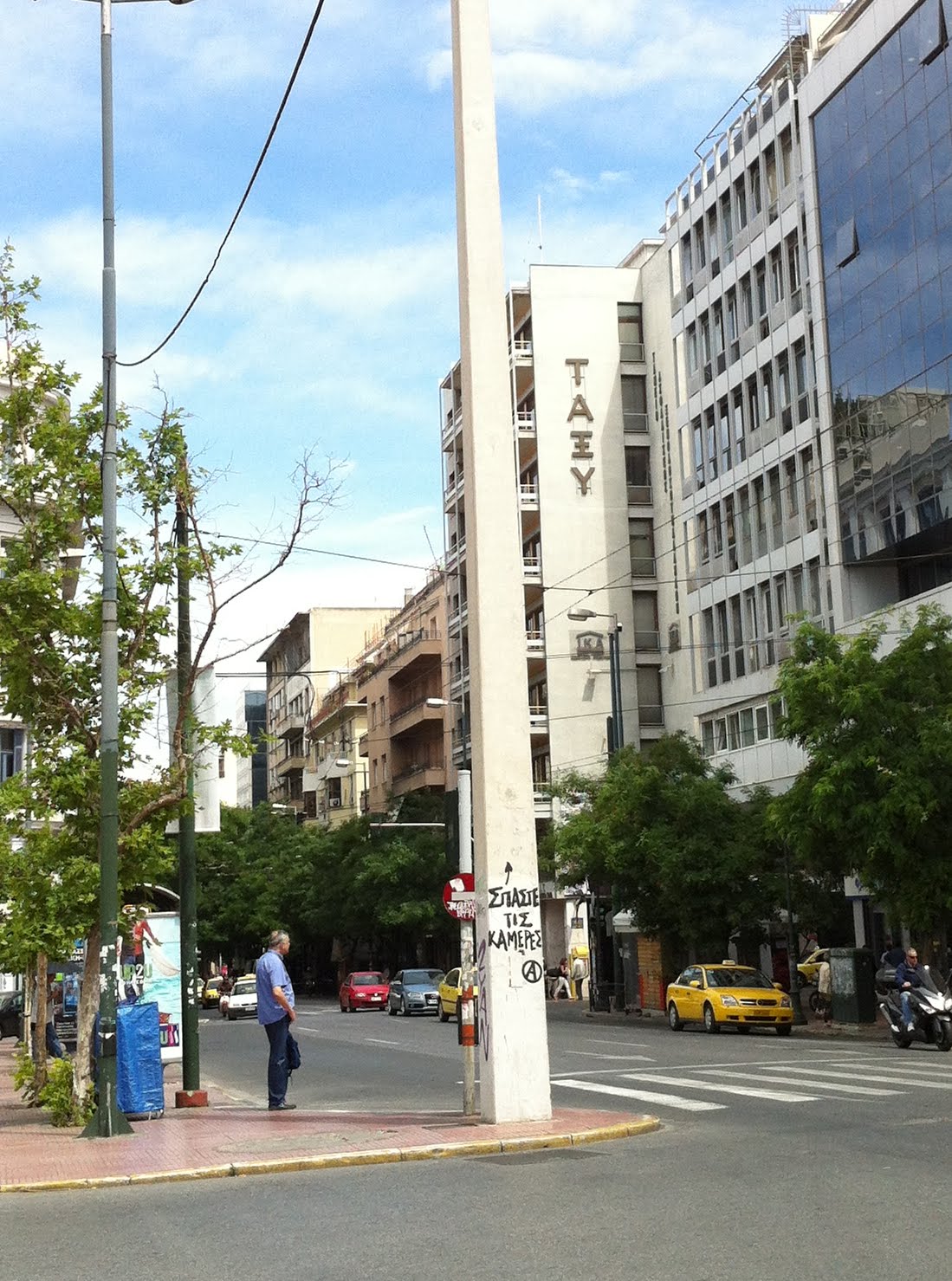
a pole supporting a surveillance camera near downtown's bus terminal with anarchist's writing (with my translation): break the cameras

Τράπεζα της Ελλάδος (Bank of Greece) near Metro station Panepistimio on Eleftheriou Venizelou Street - has no authority to print Euro bills

a statue commemorating the end of using the Greek Drahma - showing a drahma coin (ΔΡΑΧΜΗ)

a close-up of the lower part of the statue with fine print saying (with my translation): Drahma, the oldest currency in Europe stopped (circulation), and replaced by Euro on January 1, 2002

Greek traditional dance being demonstrated during a Greek festival in Munich June 27, 2010

I am happy to see the Greek traditional costume demonstrated at the same event because I haven't had a chance to shoot such a nice traditional dress here in Greece

Greek fast food being served

Greek fast food menu in German

My boy's playmate's father, a US-educated aerospace engineer, has been working in Germany for years, a family involuntarily separated by the reality of lack of work opportunity (and of people connection) here in Greece.  When his landlord decided to take his rental apartment for own use recently after many years of living in the same apartment, it took him a long time to locate a new apartment because Greeks are no longer welcome in Germany although he works there and contributes to the German GDP.

You may wonder why the rest of his family did not join him, well his wife is the only child of her family and her aging parents cannot adjust to different climate and ways of living, let along learning a new language.

When the Olympic Airline privatized a few years ago, his resume for applying for a lower-paying job in Greece (so he can be with his family) had gone unanswered probably due to his lack of connection in Greece.

Whereas a freind of my husband - a computer professor who had earned enough money abroad and had decided to return (about 5+ years ago) to contribute his expertise to teaching his beloved country's students may have started to question his wrong decision.

Other Greeks overseas may feel "no pride being a Greek", or have to conceal his identity for safety reasons.
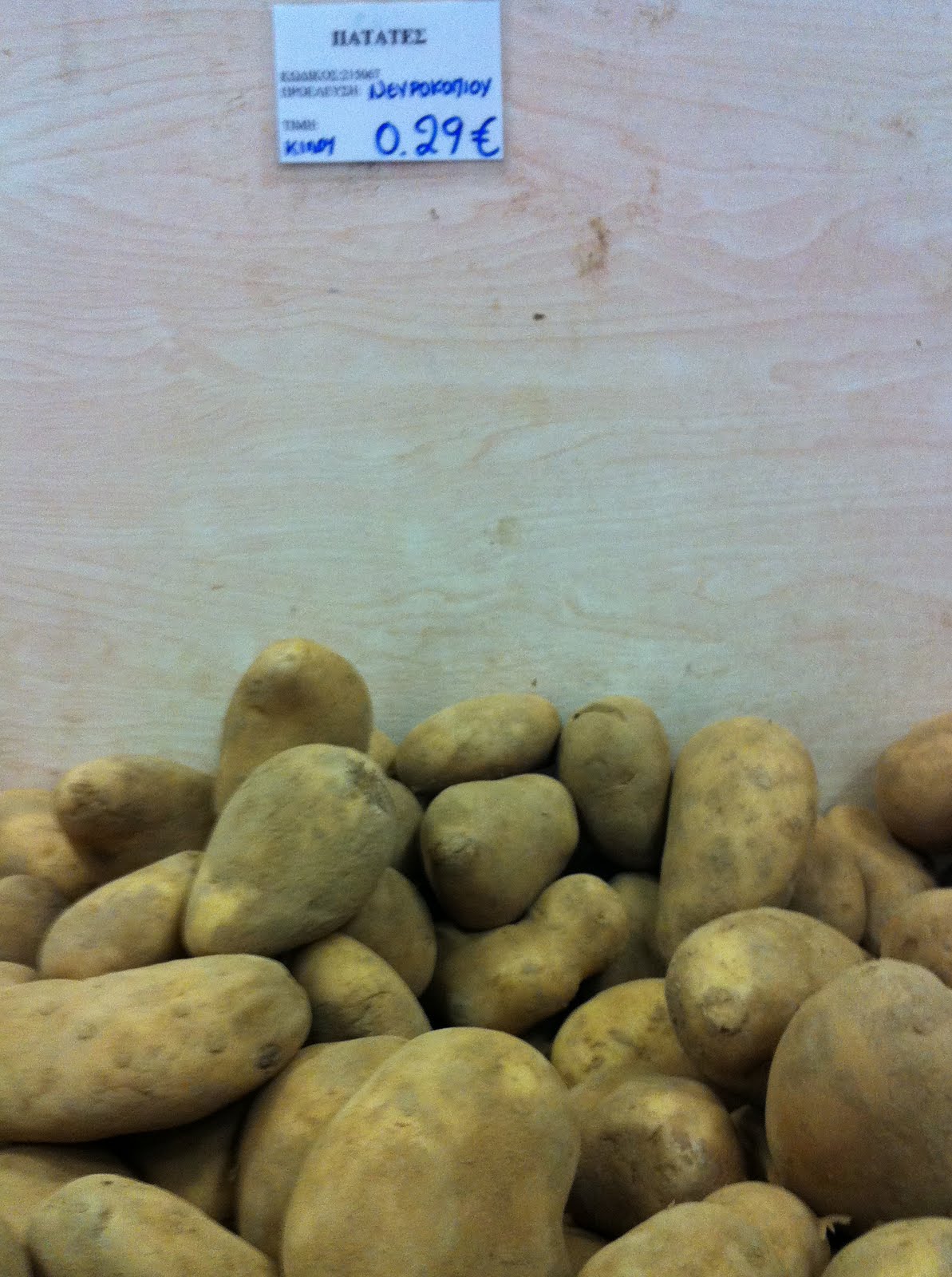
Meanwhile, the "Greek potato revolution" which was in its peak in late Feburary and early March, had disappearred?  The potato price in supermarkets remain just about as expensive as before, only slightly better than before - now at about 55 to 90 cents per kilo depending on the variety

Some Greek business is still doing well overseas - a window of the Folli Folli, a Greek designer jewellery chain, is showing that their stores are being opened one after another in many countries including Taiwan

The people of Greece are pushed to this stage where they have to pick between an experienced party that had participated in this country's most famous national sport - corruption, which was initiated by the PASOK, or an inexperienced SYRIZA who knows nothing about governing, but very experienced in rioting.

Alternatively, the politicians in Greece can set aside their differences and rebuild their bankrupt country through cooperations.

God bless Greece!

Thursday, June 14, 2012

Greek Election – Parliament closure may ease austerity


Reforms are the keys to Greece’s survival but Greek politicians are too scared of implementing them.  Most people in Greece welcome reforms carried out by foreign experts with the exception of the privileged groups of politicians and some public servants.

Does democracy work in Greece?  Greek parliamentarians are freely elected; therefore, the political system cannot be classified as undemocratic, but for the past 30 some years many dubious or contradictory laws have been passed in the Greek parliament.

If Greek citizens think that they have fulfilled their responsibilities by simply going to the polls, they have made a big mistake of not having supervised their parliament’s day–to-day operations and after years of un-scrutinization, democracy in this country is in complete failure.

A summary list of the Greek political salaries and perks exempt from austerity; minimum wage was agreed to be reduced by 22%, from €751.39 to €586.08 http://digitaljournal.com/article/319313

Greek MPs indeed cost taxpayers too much money

Double Pensions for employees of the parliament, and more…

Read the last paragraph of the above link:

“To write an article for the free edition Free Sunday the journalist sent a letter requesting information about the operating costs of the parliament, the cost of salaries and other costs of deputies, the number of the administrative employees and the costs for their salaries and about the deputies and employees salaries cutting last year. In response, they sent him from parliament three press releases from last year that respond only to the last question.”

The Greek president (whom I respect) had asked to remove himself from the government’s payroll, but how about the rest of the Greek politicians?

There is also parliamentarian’s immunity from criminal charges.

Are there too many parliamentary seats in the Greek parliament?

Yes, I think there is a BIG problem of over representation on top of the problem of paying each parliamentarian’s fat salary and benefits.

The employed people in Greece have to feed these fat politicians, who have eaten up EU grants for developing this nation, no wonder many middle-class families are hit by yet another new income tax – a surtax based on GROSS income (i.e. income before any deductions, notice this is not surtax based on tax payable like in Canada), and this is on top of what we had paid for the property tax, and the emergency tax, and the rising value-added tax on consumer products, and still not enough to rescue the sovereign debt.

The following is a comparison of the ratio (population to the number of parliamentary seats) for some countries in and outside of the European Union, the population statistics are based on either estimated or census figures for the latest year of a general election (lower house) of a country (except Greece because I didn’t find the 2012 population figure).  

Greek population 2011 census 10,787,690 (and is reducing because people got fed up with the situations and are leaving the country)
Greek parliamentary seats 300, i.e. 1 seat per 35,959 persons

German population in 2009 was 82,002,356
Elected German parliamentary seats 622, i.e. 1 seat per 131,837 persons

France population in 2007 was 63,645,065
Elected National Assembly 577 seats, Senate indirectly elected 348 seats, a total of 925 seats, i.e. 1 seat per 68,805 persons

United Kingdom population in 2010 was 62,262,000
Elected members of the House of Commons 650, plus 788 appointed members of the House of Lords, total seats 1438 i.e. 1 seat per 95,788 persons based on elected members or 1 seat per 43,298 persons based on a combined upper and lower chambers (notice that this figure is still higher than Greece)

Italy population in 2008 was 59,619,290
Elected Chamber of Deputies 630 seats, plus Senate 322 seats (of which 315 were elected inside Italy, 6 representing abroad and 1 appointed), a total combined 952 seats, i.e. 1 seat per 62,625 persons

Spain population in 2011 was 46,152,926
Elected Congress of Deputies 350 seats, Senate 266 seats (208 elected by popular vote, 58 appointed by regional legislaturs), a total of 616 seats, i.e. 1 seat per 74,924 pesons

Canada population in 2011 was 34,278,406
Elected members of parliament 308, but if including non-elected senators the total is 413, i.e. 1 seat per 111,294 persons based on elected members, or 1 seat per 82,999 persons based on a combined upper and lower chambers

Australia population in 2010 was 22,342,400
House of Representatives 150 seats, Senate 76 seats of proportional representation, a combined total of 226 seats i.e. 1 seat per 98,860 persons

Portugal population in 2011 was 10,636,979
Elected Assembly of the Republic 230 seats, i.e. 1 seat per 46,248 persons

Conclusion, Greece has the lowest population to parliamentary seat ratio of the above countries, pointing to the problem of over representation. 

Sadly, by closing the Greek parliament and inviting foreign experts to manage Greek laws and Greek sovereign debt will make Greece more competitive and will ease some unfair austerity bills passed by the Greek parliament.

Other interesting links:

Richard Koo’s prescription for Greece (and Germany)

Comparing sovereignty debt charts

Greek poll results since the last election (scroll further down the link to view a chart)

Dictionary definition of 'siphon' has been wrong for nearly a century

It is the gravity and not the difference in atmospheric pressure that makes siphon works as Dr. Stephen W Hughes clarified.
http://eprints.qut.edu.au/31098/25/A_practical_example_of_a_siphon_at_work_eprint_(2).pdf