Greeks need to stay warm while facing rising fuel costs amid unemployment.
Due to increased fuel costs, Greeks are burning woods to stay warm and this causes air pollution problem in major cities. The concentration of fine air particles has risen 30 percent since the financial crisis began, leading to potential long-term health effects.
These fine particles, measuring less than 2.5 microns in diameter, are especially dangerous because they can lodge deep into the tissue of lungs.
Read Greek Economic Crisis Leads to Air Pollution Crisis http://pressroom.usc.edu/greek-economic-crisis-leads-to-air-pollution-crisis/
The huge increase in demand for firewood has led to a surge of illegal logging. Also, funds relating to environmental projects are being channeled away from the environment to cover the national debt.
Even some thousand-year-old ancient olive trees are being chopped down to feed fire places, a great loss for Greece's cultural heritage. Read Protecting Crete's ancient olive trees from being fed to the fire
http://www.ekathimerini.com/4dcgi/_w_articles_wsite6_1_24/12/2013_533063
IOBE think-tank showing heating oil consumption has dropped by about three-quarters since 2009. In terms of revenues from heating oil tax, the government was more than 200 million Euros behind its target at the end of November. Read Smog from fireplaces in Greek cities causes political headache http://www.ekathimerini.com/4dcgi/_w_articles_wsite1_1_23/12/2013_533591
Read Creditors reject 15 pct reduction on heating oil tax http://www.ekathimerini.com/4dcgi/_w_articles_wsite2_1_11/10/2013_522724
The end results are no gains and only losses summarized below:
1. There are no increased tax revenue from collecting heating oil tax, as a matter of fact, it is a disaster policy according to this analysis. Read Quick and dirty analysis: Greek heating oil tax
http://www.udel.edu/johnmack/apec406/greek_oil_tax_analysis.html
2. During winter there is severe air pollution in major cities all over Greece causing environmental and health problems.
3. The chopping down of thousand-year-old ancient olive trees is a great loss for Greece's cultural heritage. In Taiwan old trees are respected and protected as 神木 (literally translated as "God" wood).
If you don't believe that most Greeks cannot afford to pay for the heating oil, just remember that one in two companies are not paying employees in time from this link http://www.ekathimerini.com/4dcgi/_w_articles_wsite2_1_18/12/2013_532809
This winter I have increased the frequency of food donation delivery to my local church.
Showing posts with label Greek politics 希臘政治. Show all posts
Showing posts with label Greek politics 希臘政治. Show all posts
Tuesday, December 24, 2013


Friday, July 27, 2012
A summary of this week’s news on Euro currency
The euro crisis has returned to haunt politicians and economists this week
with Greece potentially facing bankruptcy, Spain getting closer to a bailout,
and Germany risking its top credit rating.
With prolonged economic weakness and spillover for the currency
bloc, Greece will, with 90% chance as predicted by the Citigroup Inc., leave the euro zone in the next 12 to 18 months. Read
the detailed news in this link: http://www.bloomberg.com/news/2012-07-25/citigroup-sees-90-chance-that-greece-leaves-euro.html
Ifo
Institute for Economic Research has estimated that if Greece become insolvent and quits the euro
zone, Germany should expect a loss of up to 82 billion euros, while if an
insolvent Greece remains within the single currency bloc it would cost Berlin
89 billion euros. Read the detailed news in
this link and pay special attention to the paragraph at the end: http://www.reuters.com/article/2012/07/25/us-germany-economists-euro-idUSBRE86O0FA20120725
So, it follows logically that German politicians will try to steer euro zone policies towards the direction which would minimize its country's loss.
After studying the Ifo report, German
Economy Minister Philipp Rösler has drawn his conclusion - Greek exit from the
euro had "lost its horrors" - making such a comment during his interview with ARD TV on Sunday. Some senior members
in Germany's ruling coalition also agreed with him. http://www.spiegel.de/international/europe/german-economy-minister-roesler-criticized-for-comments-about-greece-a-846110.html
On Monday, the
day after Rösler’s comment,
the financial market reacted to the uncertainty of the currency - the euro fell
to its lowest level against the dollar in more than 2 years.
The Domino
effect of credit ratings
Also on
Monday, the Credit ratings agency Moody's slashed its
outlook for the creditworthiness of not only Germany, but also of the
Netherlands and Luxembourg to "negative" from "stable."
Though Moody's maintained its triple-A ratings for all three countries, it said the increasingly uncertain outlook stemming from the European debt crisis was behind the changes. Read detailed news from this link. http://www.spiegel.de/international/germany/german-press-on-moody-s-cut-to-german-credit-outlook-a-846322.html
A group of economists are calling for a radical restructuring of Europe and the euro zone to prevent a disaster of incalculable proportions. Read “Economists Warn EU on Threshold of Catastrophe" http://www.spiegel.de/international/europe/debt-crisis-economists-warn-of-euro-catastrophe-a-846327.html
NY-based
Institute for new economic thinking, INET, on July 23 2012 released a report
stating that politicians need to move decisively and timely to save the euro
currency or else it could disintegrate.
Read the report “Breaking the deadlock: a path out of the crisis”
http://ineteconomics.org/sites/inet.civicactions.net/files/INET%20Council%20on%20the%20Euro%20Zone%20Crisis%20-%2023-7-12.pdf
Europe, with many different languages and the unforgettable history of wars among them, although the Eurovision has members extending to Asia, it is skeptical that Europe has a united vision.
Without a political union, the monetary union doesn't seem to work.
Meanwhile, in Greece people will continue to cope with austerity measures with bartering, euro money has no use here when people have very little income.
Other
links:
You may also be
interested in this previous post.
Derivatives and public debt management by
Gustavo Piga
Thursday, July 26, 2012
Tourism for scholars and academics 希臘另類旅遊學者為對象
Samos, which I blogged briefly, is
one of the chosen destinations of a political tour package to
be held in August.
Political Tours, a
UK-based company organizing holiday packages in countries facing political,
financial, social and humanitarian upheaval, is organizing its first Greek
tour.
The Greek package, which
includes stops on the island of Samos, Athens, Perama and Corinth, will take a
look at the effects of austerity measures, the role of corruption, issues of
immigration, the rise of unemployment and tax evasion, among others.
I think the greatest
potential for Samos is to have more organized agricultural tourism combined
with marketing of its sweet wine. I had bought and tasted both Samos' sweet wine and Ontario ice wine, they are different both in taste and in
price and I like them both, but Samos sweet wine is more affordable.
Saturday, July 7, 2012
Corporate financial greed and Greek economic crisis
Most of us
have been taught by our parents that taking advantages of someone’s misfortune
is simply unethical.
When a country
was hit by an earth quake or tsunami, other countries will pour in humanitarian
help and the UN will provide some relief aids.
But when a
country is hit by economic crisis, vulture funds are more rampant and the UN does
not do anything (such as starting a discussion group). Indeed the UN is a non-performing (of its
mission) organization in the world of “un-united nations”.
Before you
call the Greeks lazy, you should read the articles below, and tell me if the
guys who sit and do nothing and just buy vulture funds are lazier. Greek economic crisis has many causes, but
the following causes are less known yet exacerbated the situations and need to
be mentioned more by people with conscience in the blogosphere.
What are Vulture
Funds?
The term Vulture Fund refers to a company that seeks to
profit by buying up debt in default on the secondary market for pennies on the
dollar, then trying to recover up to ten times the purchase price, often by
suing in U.S. or European courts.
While some Vulture Funds target failing companies, others go
after the sovereign debts of impoverished countries, significantly undermining
the intended impact of debt relief. These companies operate with little
transparency. As shell companies (a company set up exclusively to pursue one
goal, in this case, poor country debt), Vulture Funds are established in tax
havens like the British Virgin Islands to avoid financial constraints and
oversight. Because of the secretive incorporation strategies and locales, there
is limited or no information on who actually owns and manages these Vulture
Funds.
Low-income
countries that are eligible for debt cancellation are especially vulnerable.
Vulture Funds track the debt relief process, buy soon-to-be-relieved debt from
creditors, and then sue the poor country after it has received a windfall of
resources thanks to debt cancellation.
Corporate financial greed
Thanks to Bloomberg, some
transparency has started to surface about Greece’s secret loan from Goldman Sachs Group Inc. (GS) was a
costly mistake from the start.
On the day the
2001 deal was struck, the government owed the bank about 600 million euros
($793 million) more than the 2.8 billion euros it borrowed, said Spyros
Papanicolaou, who took over the country’s debt-management agency in 2005. By
then, the price of the transaction, a derivative that disguised the loan and
that Goldman Sachs persuaded Greece not to test with competitors, had almost
doubled to 5.1 billion euros, he said. Read the detailed article from this link.
When Greece
announced in May that it had made a €436 million bond payment to the hold-out
investors who rejected the country's historic debt revamping deal in March,
almost 90 percent of this payment was delivered to the coffers of Dart
Management, a secretive investment fund based in the Cayman Islands, according
to people with direct knowledge of the transaction. Dart is one of the best known of the
so-called vulture funds, which have a track record of buying the distressed
bonds of nearly bankrupt countries — and if they do not get paid, suing the
governments for the money. Read the detailed article on this link.
How can a country get rid of debt when these vulture
funds work against the initial intend of bailouts?
Other interesting links:
For Germans who read only the Bild and supported its POV
on the Open Letter to Greek Voters, a news for you to realize that even a German
company, Hochtief, likes to avoid paying taxes too.
End the unethical vulture funds, and a call for Greek debt audit.
Saturday, June 16, 2012
Greek Election 2012 - photos related to current affairs

a statue in downtown Athens

a close-up of the same statue shows the Greek words (with my translation): Greece wants to live, and it will
I hops so, but unless the Greek politicians cooperate and set aside their differences, plus the parliament "cleans its house", it may become like the old Greece shortly after the Second World War.
If I were a Troika official, this will be one of my negotiation demands: that the newly-elected Greek MPs from tomorrow's election receive only the minimum wage with no extra benefits what so ever.
The Troika should have scrutined the operating cost of the Greek parliament compared to those of the other European countries.
The Troika was partially responsible for fueling the development of the SYRIZA and other extremist groups because the cut on MPs salaries & benefits is minimal compared to the austerity inflicted upon the most vulnerable people in the society.

a photo of Greek president Karolos Papoulias from my TV during a military parade on March 25 2010, but a military parade on October 28 2011 was cancelled due to a demonstration partly sponsored by SYRIZA.
People should not vent their anger on Papoulias (not a traitor), nor on foreign advisors trying to bailout Greece (not invaders).

Anarchists had drawn graffti all over the city of Athens including on historical buildings

a close-up of the same building shows the Greek words (with my translation): gasoline and fire on each bank
After tomorrow's election, if SYRIZA wins the majority, will the anarchisis still be against the "government" ? Or will Tsipras dispatch SYRIZA party volunteers to clean-up all the anti-government slogans in Athens?

marble pieces were smashed and removed during protests, this is what's left on a peaceful day near Syntagma (the Constitution Square)

a statue of a hero named Kolokotronis during the Greek War of Independence (1821 - 1832) in downtown Athens

a close-up of the same statue with more clear Greek words (with my translation): riot now, the rest is in English: Fxxx heroes, fight now, and the anarchist's symbol - an encircled capital letter A
The original text underneath the graffiti is in ancient Greek, I can only read partially due to my lack of knowledge, and if you can read the whole text, please provide translation in the reader's comment area.
Anarchists in Greece do not just disobey government authority, they are hooligans that destroy their country's economy (as in riots & lootings of commercial streets after demonstrations), as well as tourism industry (who wants to see historical buildings covered with graffiti?)
Greece is a fertile country, poorly managed by its corrupted politicians, and wounded by the self destruction force of its anarchists

vs. a statue in Munich's Marienplatz - no graffiti, how nice for a tourist to shoot

vs. a statue in Munich's Nymphenburg Palace - again no graffiti

sometimes instead of graffiti, the road sign is changed or covered up, here the station name "θησείο" (Thi-si-o) had been altered to "Οησείο" (o-i-si-o)
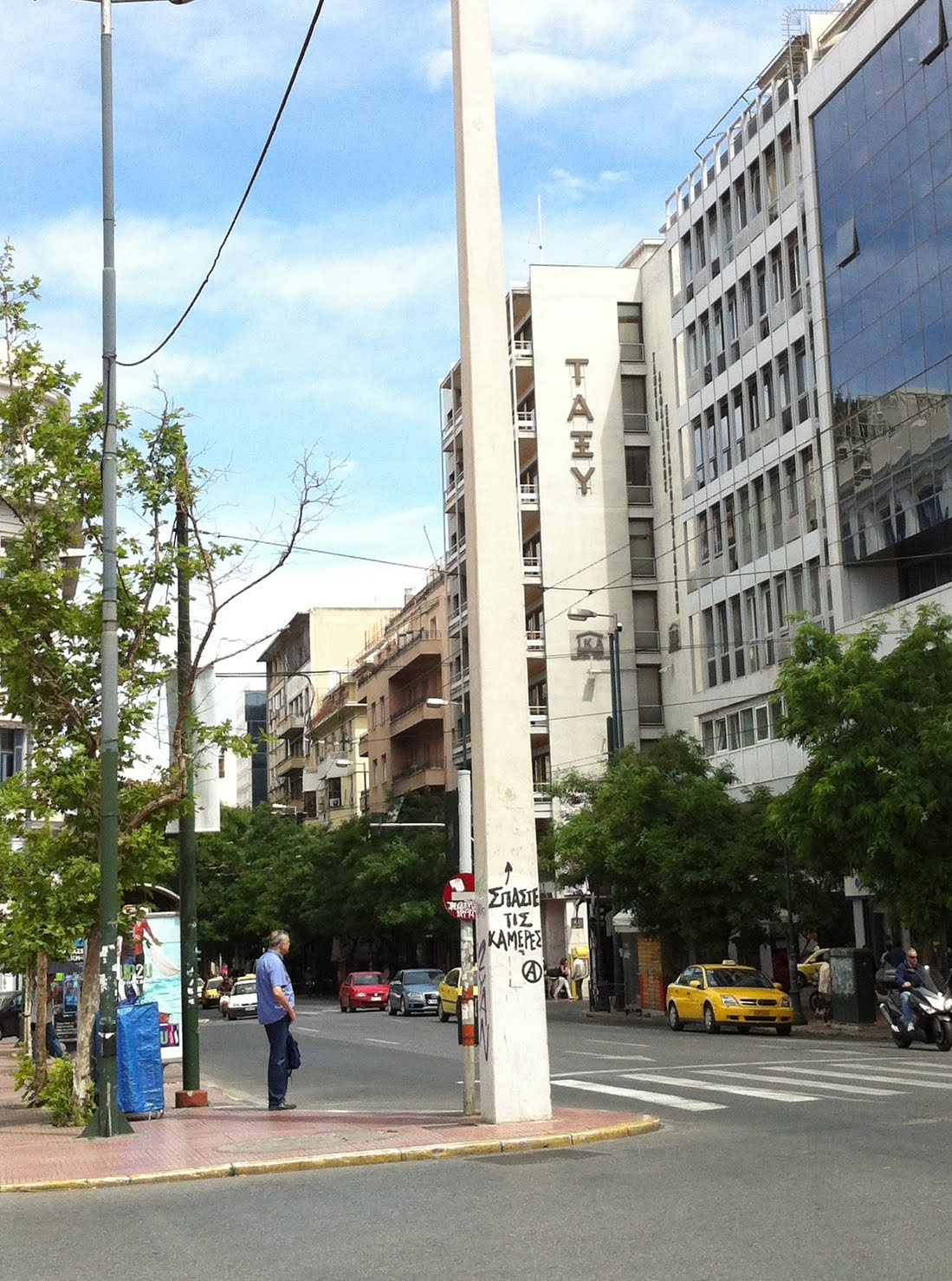
a pole supporting a surveillance camera near downtown's bus terminal with anarchist's writing (with my translation): break the cameras

Τράπεζα της Ελλάδος (Bank of Greece) near Metro station Panepistimio on Eleftheriou Venizelou Street - has no authority to print Euro bills

a statue commemorating the end of using the Greek Drahma - showing a drahma coin (ΔΡΑΧΜΗ)

a close-up of the lower part of the statue with fine print saying (with my translation): Drahma, the oldest currency in Europe stopped (circulation), and replaced by Euro on January 1, 2002

Greek traditional dance being demonstrated during a Greek festival in Munich June 27, 2010

I am happy to see the Greek traditional costume demonstrated at the same event because I haven't had a chance to shoot such a nice traditional dress here in Greece

Greek fast food being served

Greek fast food menu in German
My boy's playmate's father, a US-educated aerospace engineer, has been working in Germany for years, a family involuntarily separated by the reality of lack of work opportunity (and of people connection) here in Greece. When his landlord decided to take his rental apartment for own use recently after many years of living in the same apartment, it took him a long time to locate a new apartment because Greeks are no longer welcome in Germany although he works there and contributes to the German GDP.
When the Olympic Airline privatized a few years ago, his resume for applying for a lower-paying job in Greece (so he can be with his family) had gone unanswered probably due to his lack of connection in Greece.
Whereas a freind of my husband - a computer professor who had earned enough money abroad and had decided to return (about 5+ years ago) to contribute his expertise to teaching his beloved country's students may have started to question his wrong decision.
Other Greeks overseas may feel "no pride being a Greek", or have to conceal his identity for safety reasons.


The people of Greece are pushed to this stage where they have to pick between an experienced party that had participated in this country's most famous national sport - corruption, which was initiated by the PASOK, or an inexperienced SYRIZA who knows nothing about governing, but very experienced in rioting.
Alternatively, the politicians in Greece can set aside their differences and rebuild their bankrupt country through cooperations.
God bless Greece!
Thursday, June 14, 2012
Greek Election – Parliament closure may ease austerity
Reforms are the
keys to Greece’s survival but Greek politicians are too scared of implementing
them. Most people in Greece welcome
reforms carried out by foreign experts with the exception of the privileged
groups of politicians and some public servants.
Does democracy
work in Greece? Greek parliamentarians
are freely elected; therefore, the political system cannot be classified as
undemocratic, but for the past 30 some years many dubious or contradictory laws
have been passed in the Greek parliament.
If Greek citizens think that they
have fulfilled their responsibilities by simply going to the polls, they have
made a big mistake of not having supervised their parliament’s day–to-day operations and after years of un-scrutinization, democracy in this country is in complete failure.
A summary list of
the Greek political salaries and perks exempt from austerity; minimum wage was
agreed to be reduced by 22%, from €751.39 to €586.08 http://digitaljournal.com/article/319313
Greek MPs indeed cost
taxpayers too much money
Double Pensions for
employees of the parliament, and more…
Read the last
paragraph of the above link:
“To write an article for the free edition
Free Sunday the journalist sent a letter requesting information about the
operating costs of the parliament, the cost of salaries and other costs of
deputies, the number of the administrative employees and the costs for their
salaries and about the deputies and employees salaries cutting last year. In
response, they sent him from parliament three press releases from last year
that respond only to the last question.”
The Greek president (whom
I respect) had asked to remove himself from the government’s payroll, but how
about the rest of the Greek politicians?
There is also parliamentarian’s
immunity from criminal charges.
Are there too many parliamentary
seats in the Greek parliament?
Yes, I think there is a
BIG problem of over representation on top of the problem of paying each
parliamentarian’s fat salary and benefits.
The employed people in
Greece have to feed these fat politicians, who have eaten up EU grants for
developing this nation, no wonder many middle-class families are hit by yet
another new income tax – a surtax based on GROSS income (i.e. income before any
deductions, notice this is not surtax based on tax payable like in Canada), and
this is on top of what we had paid for the property tax, and the emergency tax,
and the rising value-added tax on consumer products, and still not enough to
rescue the sovereign debt.
The following is a
comparison of the ratio (population to the number of parliamentary seats) for
some countries in and outside of the European Union, the population statistics
are based on either estimated or census figures for the latest year of a general
election (lower house) of a country (except Greece because I didn’t find the 2012
population figure).
Greek population 2011
census 10,787,690 (and is reducing because people got fed up with the
situations and are leaving the country)
Greek parliamentary
seats 300, i.e. 1 seat per 35,959 persons
German population in 2009
was 82,002,356
Elected German parliamentary
seats 622, i.e. 1 seat per 131,837 persons
France population
in 2007 was 63,645,065
Elected National
Assembly 577 seats, Senate indirectly elected 348 seats, a total of 925 seats,
i.e. 1 seat per 68,805 persons
United Kingdom population
in 2010 was 62,262,000
Elected members of the
House of Commons 650, plus 788 appointed members of the House of Lords, total seats
1438 i.e. 1 seat per 95,788 persons based on elected members or 1 seat per 43,298
persons based on a combined upper and lower chambers (notice that this figure
is still higher than Greece)
Italy population in
2008 was 59,619,290
Elected Chamber of
Deputies 630 seats, plus Senate 322 seats (of which 315 were elected inside
Italy, 6 representing abroad and 1 appointed), a total combined 952 seats, i.e.
1 seat per 62,625 persons
Spain population in
2011 was 46,152,926
Elected Congress of
Deputies 350 seats, Senate 266 seats (208 elected by popular vote, 58 appointed
by regional legislaturs), a total of 616 seats, i.e. 1 seat per 74,924 pesons
Canada population
in 2011 was 34,278,406
Elected members of
parliament 308, but if including non-elected senators the total is 413, i.e. 1
seat per 111,294 persons based on elected members, or 1 seat per 82,999 persons
based on a combined upper and lower chambers
Australia population
in 2010 was 22,342,400
House of Representatives
150 seats, Senate 76 seats of proportional representation, a combined total of
226 seats i.e. 1 seat per 98,860 persons
Portugal population in
2011 was 10,636,979
Elected Assembly of
the Republic 230 seats, i.e. 1 seat per 46,248 persons
Conclusion, Greece has the lowest population to parliamentary seat ratio of the above countries, pointing to the problem of over representation.
Sadly, by closing the
Greek parliament and inviting foreign experts to manage Greek laws and Greek
sovereign debt will make Greece more competitive and will ease some
unfair austerity bills passed by the Greek parliament.
Other interesting links:
Richard Koo’s
prescription for Greece (and Germany)
http://ftalphaville.ft.com/blog/2012/05/30/1022281/richard-koos-prescription-for-greece-and-germany/
Comparing sovereignty
debt charts
Greek poll
results since the last election (scroll further down the link to view a chart)
Dictionary definition
of 'siphon' has been wrong for nearly a century
It is the gravity and
not the difference in atmospheric pressure that makes siphon works as Dr.
Stephen W Hughes clarified.
http://eprints.qut.edu.au/31098/25/A_practical_example_of_a_siphon_at_work_eprint_(2).pdf
Monday, February 13, 2012
Structural reform should start from riot control in downtown Athens
Why after the lesson learned from the riot of December
2008, Greek police still fight street rioters with tear gas and not trying some
alternative ways of control measures such as using water cannons? Is it because the government has spent money
for politicians’ armored cars to protect themselves from occasional personal attacks
and therefore there was no budget allocated for purchasing crowd control
vehicles such as water cannons to disperse anarchists / looters and protect
downtown business?
Last
night's destruction in downtown Athens is predictable and simply pours salt
on the already wounded economy. A
neo-classical building home to the Attikon cinema dating from 1870 was also
among the 45+ buildings burned. I think
water cannons should have come to disperse the potential looters after an
initial warning from the police, sending fire trucks to put off the fires after buildings
are set ablaze is a step too late.
New austerity measures are too harsh with its
effectiveness to be evaluated in a few months, so far it causes recession and hardship
on honest people who have paid enough shares of the tax burden, crime rate
soared, plus many homeless
people sought refuge under recent severe weather conditions. On the contrast, did
the IMF, part of the Troika, pay tax on its vehicles used in Athens?
Recently Balkan
states are freezing, northern Greece has more snow than usual, and Pyrgos Ilias in the west Peloponnesos
Greece was flooded, one Taiwanese Greek's home was affected by the flood in
that region. We pray that the bad
weather will soon end.
Upcoming events:
The 2012 Athens Tourism Symposium, the
international scientific congress on current trends in tourism management and
tourism policy, will open at the Athens Ledra Marriott Hotel (115 Syngrou) on
Feb 15 &16, 2012.
The “Tourism
and Gastronomy in the Spotlight” event will also open at the Athens Ledra
Marriott Hotel (115 Syngrou) on Feb 15 &16, 2012.
Some links:
Fire protection
engineering is a field of study that we need to have in Greek universities.
A very
interesting bird wiki site: videos, photos, and sounds at the Internet Bird Collection.
Sunday, January 22, 2012
Salute to an unsung Greek hero Dimitrios Karamolegos Διμήτριος Καραμολέγκος
This is
the first post of 2012, I hope this post be one that is short but make some
impact on how Greeks and especially Greek politicians think about the future of
their country.
This post
I pay my respect to an unsung Greek hero who lost his life protecting his
country's land - unpaid.
In
Greece, I have high respect for firefighters, but not so for parliamentarians /
politicians, and medical doctors. The parliamentarians / politicians like
to pass laws that safeguard their own interests while many doctors like to
evade taxes, on top of this, many doctors are also smokers, so they don't
practice what they are supposed to preach - maintaining healthy life style.

This is an image of a
marble memorial plaque in remembrance of 4 firefighters, the first two are
chiefs named Dimitrios Maloukos Διμήτριος ΜΑΛΟΥΚΟΣ and Themistoklis Mavra-idis
Θεμιστοκλής ΜΑΥΡΑΕΙΔΗΣ, the 3rd is a firefighter named Alexandros Diavolis
Αλέξανδρος ΔΙΑΒΟΛΗΣ, the last one is a volunteer patrol named Dimitrios Karamolegos
Διμήτριος ΚΑΡΑΜΟΛΕΓΚΟΣ.
Greece's biggest threat
to environment each summer is forest fire, hopefully after drawing up maps
showing forest land will
help curb some of the suspected arsons around the Attica region (note: greater
Athens belongs to the Attica region).
I remember reading news
back in November 2011 that New Democracy leader, Antonis Samaras didn't want
his party's most capable personnel join the current interim government, he
was thinking of reserving them until he wins the next election.
If you are a captain in
a sinking ship, do you dispatch all your crews to save the ship or do you
reserve them until the ship sinks, I wonder?
This is the reason why I
respect so much this volunteer young forest
patrol, Dimitrios Karamolegos Διμήτριος Καραμολέγκος, it's
probably good that he didn't live to see his fellow countrymen suffer under the
austerity measures.
Unemployment rate for
young people is around 40% while overall unemployment rate is near 20%, this
does not include many people who are working but not getting paid in time and
expect their employers to pay them 6 months down the road in order to help
their employers coping with their financial crisis.
Those people like
doctors and some other self-employed who have evaded taxes by not declaring their
proper incomes are mostly unaffected by the austerity measures, but those who
have already paid their fair shares are now paying even more because the
emergency taxes are levied based on previous year's declaration of tax
positions.
How about setting up a "shrinking sovereign debt account" by the Ministry of Economics for people who would like to "donate", giving people a chance to contribute to help shrinking the national debt, including giving tax evaders a chance to "come clean" by introducing guidelines for voluntary disclosure of their past economic "crime" without charging any penalty as long as they pay back?
In closing, please read
a very good editorial piece by English Kathimerini's deputy editor Nick
Malkoutzis on "Caution: Falling
wages", it's a must read
for Greek decision makers as well as Troika officials. Before dropping
private wages, why not downsize public service first?
Subscribe to:
Posts (Atom)