Most EU citizens don’t want the GM (genetic modified) corn, but the European Commission (EC) and a few bigger states' politicians do, following some bizarre procedure called "comitology" and a German abstention, the EC power is forcing a genetically engineered maize into Europe’s agriculture.
Despite 19 of the EU’s 28 members voted against, the pro-GM Tonio Borg (European Commissioner for Health), claims that under a procedure known as "comitology" http://en.m.wikipedia.org/wiki/Comitology, the EC shall approve the maize. (The content of this link has completed been changed in a very short time, indicating EC government employees working full-time to alter the contents of wikipedia and don't like people to know what is comitology, initially the link is http://en.m.wikipedia.org/wiki/Comitology, it explains just the EC committee's strange and undemocratic ways of passing laws, without mentioning maize approval at all, but the initial text has disappeared in no time)
“If there is no negative qualified majority against the proposal then the Commission not may, but shall, adopt the proposal,” said Tonio Borg. Read http://www.euronews.com/2014/02/11/gmo-corn-from-du-pont-dow-gets-green-light-in-europe/
UK, Spain. Finland, Estonia and Sweden voted in favour, while Belgium, Portugal and the Czech Republic abstained. But the critical abstention was the big vote carrying Germany. For some unknown reason, each vote did not carry the same weight, which cleared the way for the approval.
Read more details from http://www.gmeducation.org/government-and-corporations/p217267-will-a-bizarre-vote-finally-let-gmo-maize-into-europe.html
If 19 out of 28 is not a majority, I don't know what is?!
The European Parliament has long had a problem with the lack of transparency of comitology committees, stemming mainly from the fact that Members of the European Parliament (MEPs) are excluded from the comitology process. A broader concern has been voiced about the public accountability of comitology. As sites of European governance which produce a vast amount of binding legislation, comitology's opaque mode of operation, unclear membership, and closed debate style has been the subject of criticism from academics for years.
When the majority of EU citizens don't want it, but the greed of those GM corporations is winning each battle, what's the use of going to the poll to vote for our EU parliament members if the EC can find some loopholes and impose regulations against citizens' wish? Democracy is dead in Europe!
We need a EU referendum on GM seeds if politicians only bow their heads to GM giants against people's will.
Health is a universal issue, if you are not a citizen of EU (say if you live in my home country, Taiwan), you should still read on because Taiwan often bases its regulations and testing standards on US.
The US has the revolving door problem i.e. former GM industry employees taking up FDA (Food and Drug Adm) posts to serve the commercial interests of the GM corporations instead of regulating to safeguard public health. Click the first red section titled "Monsanto's Government Ties" on opening the link below http://www.organicconsumers.org/monsanto/news.cfm
EU should block its revolving door problem http://www.alter-eu.org/revolving-doors/block-the-revolving-door because too many EU officials were former lobbyists and will work again in lobbying once they finish their terms in the public sector. Over half of the 209 scientists sitting on the European Food Safety Authority (EFSA) agency's panels have direct or indirect ties with the industries they are meant to regulate. http://corporateeurope.org/efsa/2013/10/unhappy-meal-european-food-safety-authoritys-independence-problem
Proposal that individual EU country can ban GM crop is just a trap
"A new strategy on GM issues" - a report by the Brussels biotech lobby group EuropaBio (the name sounds like pro-organic but it is actually a pro-GM lobbying firm) concluded that a new approach is needed to break the standstill on GM crops in Europe. This includes an "amended nationalisation proposal" putting as a condition that member states can only apply for a national ban if they have first asked the company to refrain from marketing the GM crop in their country, and if the company has refused. Read Biotech lobby's fingerprints over new EU proposal to allow national GMO bans http://corporateeurope.org/food-and-agriculture/2014/05/biotech-lobbys-fingerprints-over-new-eu-proposal-allow-national-gmo
Wind, birds, honey bees can carry GM seeds and cross-pollinate with natural seeds, thereby destroying the existing export credential of farmers who grow conventional seeds and always work hard to remove weeds without chemical sprays. Wind, birds, and bees travel regardless of national borders, so if one country in EU says yes to GM seed, the neighboring country will be contaminated soon despite saying no. Besides, with the entrance of GM seeds, more pesticide will be sprayed in European farms.
Unless the no-to-GM countries can seek monetary compensation for the contamination of GM seeds and of pesticide into their fields from those countries that say yes-to-GM, otherwise, it will be unfair to the majority of countries that had voted no.
Some US conventional seed farmers have experienced rejects by importing countries because their products have been tested to be GM contaminated, losing their exporting potential, and increasing their costs of pre-exporting analytical tests to ensure products are free from GM contamination, the US conventional farmers are in courts fighting for their rights against the GM industry. Example, Japan Rejects Import Of U.S. Wheat: Polluted With GMOs http://www.collective-evolution.com/2013/05/31/japan-rejects-import-of-u-s-wheat-polluted-with-gmos/ and Organic Farmers vs. Monsanto: Final Appeal to U.S. Supreme Court to Protect Crops from GMO Contamination http://ecowatch.com/2013/12/24/farmers-monsanto-gmo-contamination/
Chronology of the US conventional farmers' wars against Monsanto http://www.osgata.org/osgata-et-al-v-monsanto/
Allowing the initial testing of GM seeds to grow outside of a controlled environment (and all the time in undisclosed secret locations), allowing GM seed patenting - thus enabling GM corporations to control seeds and expand quickly to monopolize the seed markets (replacing conventional seeds with GM seeds leaving US farmers without a choice) while not carrying out independent longer-term studies of health effects of eating GM food, plus purposely disallowing clear food labeling (in favor of GM industry and against consumers' wish) are the biggest mistakes of the US authorities.
Although (most of) Europe does not grow GM corns, Spain does, and many animals are fed with imported GM corns too. I checked the Corn Flakes box and it is produced in Spain, so I will stop buying it as I don't have confidence that I am feeding my children healthy food. I also prefer local meat products.
The GM seeds have already contaminated the soil of farmers who grow conventional seeds around the globe (but mostly in US), in US 90% of corns are genetically modified, but recently their corns got sick easily, they started to realize the importance of seed diversity.
"No one is certain why Goss’s wilt has become so rampant in recent years. But many plant pathologists suspect that the biggest factor is the hybrids chosen for genetic modification by major seed companies like Monsanto, DuPont and Syngenta."
"My theory is that there were a couple of hybrids planted that were selected because they had extremely high yield potentials," said Dr. Robertson, whose research is financed by Monsanto and the Agriculture Department.
"They also may have been highly susceptible to Goss’s wilt."
Read the entire article Is Lack of Genetic Diversity and Crop Diversity Accelerating a New Epidemic in Corn http://www.seedmatters.org/is-lack-of-genetic-diversity-and-crop-diversity-accelerating-a-new-epidemic-in-corn/
With the US devastated by the recent corn disease, if the EU follows the same path and has the similar problem in future, that will be the beginning of the worldwide shortage of food and animal feed crisis.
Ecological farming is the better way to farm while keeping our environment free from toxic chemicals. Read one example of eco farming in Vietnam http://www.gmeducation.org/government-and-corporations/p217582-no-gmos-and-no-pesticides:-vietnamese-farmers-use-flowers-to-protect-rice.html
What are the GM corns?
They are corn varieties resistant to glyphosate herbicides and the first variety was commercialized in 1996 by Monsanto, known as MON 810 - Roundup Ready Corn.
Roundup (glyphosate) is a weedkiller sold by Monsanto, by using the Roundup Ready Corn (MON 810), farmers can spray the entire field using Roundup to kill the weed but not the corn. Since the MON 810 corn is genetically modified to resist Roundup, farmers spray pesticide when weeds come out while the corns adjacent to weeds are "eating" just as much pesticide. This way, Monsanto has profited from selling both the Roundup weedkiller and the patented GM MON 810 corn seed.
Often the food and drug regulatory authorities approve new products base only on the (misleading) info provided by the GM industry without other independent studies by research groups unrelated to or not sponsored by the GM companies.
An independent study by the Séralini research team found that beyond 90 days of consuming the GM corn, rats have developed tumors.
Unfortunately not just democracy is dead in EU, scientific advancement and academic freedom are hindered by GM industry's greed.
In May 2013, six months after the Séralini study release, Elsevier (note: the publisher for FCT, Food and Chemical Toxicology) announced that it had created a new position, “Associate Editor for Biotechnology.” The person they hired to fill it was Richard E. Goodman, a former Monsanto employee who in addition was with the Monsanto pro-GMO lobby organization, the International Life Sciences Institute (ILSI) which develops industry-friendly risk assessment methods for GM foods and chemical food contaminants and inserts them into government regulations.
As one critical scientific website posed the obvious ethical sham of hiring Monsanto people to control GMO publications, “Does Monsanto now effectively decide which papers on biotechnology are published in FCT? And is this part of an attempt by Monsanto and the life science industry to seize control of science?"
Then on November 24, 2013, six months after Goodman took control of GMO issues at the Journal, Dr A. Wallace Hayes, the editor of the journal Food and Chemical Toxicology decided to retract the study by the team of Professor Séralini. (threatened to lose his job?)
Read details of Séralini research and retraction of publication controversy http://www.globalresearch.ca/the-toxic-impacts-of-gmo-maize-scientific-journal-bows-to-monsanto-retracts-anti-monsanto-study/5360394
Séralini’s team studied the effect of a Monsanto GMO maize diet on the rats for much longer than Monsanto had in their study submitted to the EU European Food Safety Authority for approval. They did their study for the full two year average life-time instead of just 90 days in the Monsanto study. The long time span proved critical. The first tumors only appeared 4 to 7 months into the study. In industry’s earlier 90-day study on the same GMO maize Monsanto NK603, signs of toxicity were seen, but were dismissed as “not biologically meaningful” by industry and EFSA alike. More details about the experiment and the corrupted EFSA officials see this http://www.globalresearch.ca/stench-of-eu-corruption-in-monsanto-gmo-whitewash/5316294
Monsanto’s analysis compared unrelated feeding groups, muddying the results. The June 2009 rebuttal explains, "In order to isolate the effect of the GM transformation process from other variables, it is only valid to compare the GMO…with its isogenic non-GM equivalent."
The (Séralini) researchers conclude from all three GMO studies that novel pesticide residues will be present in food and feed and may pose grave health risks to those consuming them. They have called for "an immediate ban on the import and cultivation of these GMOs and strongly recommend additional long-term (up to two years) and multi-generational animal feeding studies on at least three species to provide true scientifically valid data on the acute and chronic toxic effects of GM crops, feed and foods." Read Three Approved GMOs Linked to Organ Damage by Rady Ananda http://zcomm.org/zmagazine/three-approved-gmos-linked-to-organ-damage-by-rady-ananda/
Not only eating the GM corn may cause health problem, the Roundup weedkiller was a health risk - used in gardens, farms, and parks around the world, Roundup contains an ingredient that can suffocate human cells in a laboratory, researchers say on Jun 23, 2009. Read Weed-Whacking Herbicide Proves Deadly to Human Cells http://www.scientificamerican.com/article/weed-whacking-herbicide-p/
A Canadian study shows GM DNA can cross the placental barrier. They said it would never happen.
http://www.gmeducation.org/briefings/p149281-genetically-modified-dna-found-in-foetal-blood.html
Real scientific research should be one that quest for new knowledge, not one that covers up negative findings to serve the commercial interests of a special group.
The FDA researchers were fired, threatened, or relocated to other jobs when they wanted to do their job right.
The example below is related to the testing of milk safety with cows being injected with artificial hormone:
Veterinarian Richard Burroughs, who had a lead role in the review process, was shocked at how few tests the agency was requiring. Burroughs ordered more tests, but was soon fired. He said, “I was told that I was slowing down the approval process.” Burroughs says that the science in the studies was well outside the expertise of FDA employees, but officials “suppressed and manipulated data to cover up their own ignorance and incompetence.” Alexander Apostolou, director of the FDA's Division of Toxicology, says, “Sound scientific procedures for evaluating human food safety of veterinary drugs have been disregarded.” When he expressed his concerns at the agency, he was pressured to leave.” Chemist Joseph Settepani testified at a public hearing about “a systematic human food-safety breakdown at the Center for Veterinary Medicine.” Prior to his testimony, he was in charge of quality control for veterinary drug approvals. Soon after, he was stripped of his duties as a supervisor and sent to work in a trailer at an experimental farm.
GM industry tried to bribe Canadian researchers into approval
While Monsanto's tactics have been fairly effective in the United States, they have tried equally hard north of the border. In 1998, six Canadian government scientists testified that they were being pressured by superiors to approve rbGH. The six were employed by Health Canada — the Canadian equivalent of the US FDA. Their job was to determine if the milk from treated cows was safe to drink. They didn't think so. In fact, they had compiled a detailed critique of the FDA's evaluation of rbGH, showing that the US approval process was flawed and superficial. However, senior Canadian officials and Monsanto tried to force the Canadians to approve it anyway.
According to the Toronto Globe and Mail (note: The Globe and Mail is a national paper circulated in Canada not just a Toronto local paper), “The scientists' testimony before a Senate committee was like a scene from the conspiratorial television show 'The X-Files.'” They told the senators that government scientists “often feel that their careers are threatened if they stand in the way of a drug they don't believe is safe,” and “managers without scientific experience regularly overrule their decisions.”
Dr. Margaret Haydon said that when she refused to approve rbGH due to her concerns for human health, she was taken off the study. The Ottawa Citizen reported that Haydon “recounted how notes and files critical of scientific data provided by Monsanto were stolen from a locked filing cabinet in her office,” and that she “told of being in a meeting when officials from Monsanto...made an offer of between $1 million and $2 million to the scientists from Health Canada — an offer that she told the senators could only have been interpreted as a bribe.” Read details from A Short History of Genetically Engineered Bovine Growth Hormone by Jeffrey Smith http://www.councilforresponsiblegenetics.org/ViewPage.aspx?pageId=125
What European parliament needs to do without delay is to start an investigation into the corrupted EC officials and to stop the revolving door - enact a law that will effectively prohibit conflict of interest appointments.
And the UN should enact clear food labeling law for world trade, and prohibit seed patenting as it is against the nature. Besides, GM seeds should not be allowed to contaminate the crops of disadvantaged nations by means of so called "foreign aids" because of disaster or famine, receiving ends should have a choice - advised if the "aids" contain GM crops.
A clear labeling law means for processed food the label should include ingredients' percentage followed by the country code, followed by a GM indicator. If for a specific ingredient, it has a mixture coming from 2 different countries, immediate following the ingredient percentage, the first country code be written for the major supplier of the ingredient and the second country code followed since it is the secondary supplier, all ingredients must be clearly labeled with a GM indicator.
After all, if the GM food is so great as promoted by the GM industry, why it isn't in the menu at the cafeteria of Monsanto's facility?
Read Monsanto' canteen in UK does not serve GM food
http://www.greenpeace.org/seasia/ph/News/greenpeace-philippine-blog/eat-it-up-monsanto/blog/39039/
The GM food should not just stop at the EU border, it should be wiped out from our globe regardless of border. We should start to revert back to green revolution, repecting the natural ecological system.
Related links:
You must read this: Continuing the Green Revolution:
The corporate assault on the security of the global food supply http://www.mit.edu/~thistle/v13/4/food.html
Who grows what in GM seeds
http://www.genewatch.org/sub-532326
or another good source at the GM approval data base from the organization servicing the interests of the GM corporations http://www.isaaa.org/gmapprovaldatabase/default.asp
Revealed how seed market is controlled by Monsanto, Syngenta, Bayer, Dow & DuPont http://www.theecologist.org/News/news_round_up/625294/revealed_how_seed_market_is_controlled_by_monsanto_syngenta_bayer_dow_dupont.html
The video of the Séralini research team from the left-side of this page http://www.gmeducation.org
Scientists' hidden links to the GM food giants: Disturbing truth behind official report that said UK should forge on with Frankenfoods http://www.dailymail.co.uk/news/article-2581387/Scientists-hidden-links-GM-food-giants-Disturbing-truth-official-report-said-UK-forge-Frankenfoods.html
Showing posts with label int'l trade 國際貿易. Show all posts
Showing posts with label int'l trade 國際貿易. Show all posts
Wednesday, June 4, 2014


Saturday, June 16, 2012
Greek Election 2012 - photos related to current affairs

a statue in downtown Athens

a close-up of the same statue shows the Greek words (with my translation): Greece wants to live, and it will
I hops so, but unless the Greek politicians cooperate and set aside their differences, plus the parliament "cleans its house", it may become like the old Greece shortly after the Second World War.
If I were a Troika official, this will be one of my negotiation demands: that the newly-elected Greek MPs from tomorrow's election receive only the minimum wage with no extra benefits what so ever.
The Troika should have scrutined the operating cost of the Greek parliament compared to those of the other European countries.
The Troika was partially responsible for fueling the development of the SYRIZA and other extremist groups because the cut on MPs salaries & benefits is minimal compared to the austerity inflicted upon the most vulnerable people in the society.

a photo of Greek president Karolos Papoulias from my TV during a military parade on March 25 2010, but a military parade on October 28 2011 was cancelled due to a demonstration partly sponsored by SYRIZA.
People should not vent their anger on Papoulias (not a traitor), nor on foreign advisors trying to bailout Greece (not invaders).

Anarchists had drawn graffti all over the city of Athens including on historical buildings

a close-up of the same building shows the Greek words (with my translation): gasoline and fire on each bank
After tomorrow's election, if SYRIZA wins the majority, will the anarchisis still be against the "government" ? Or will Tsipras dispatch SYRIZA party volunteers to clean-up all the anti-government slogans in Athens?

marble pieces were smashed and removed during protests, this is what's left on a peaceful day near Syntagma (the Constitution Square)

a statue of a hero named Kolokotronis during the Greek War of Independence (1821 - 1832) in downtown Athens

a close-up of the same statue with more clear Greek words (with my translation): riot now, the rest is in English: Fxxx heroes, fight now, and the anarchist's symbol - an encircled capital letter A
The original text underneath the graffiti is in ancient Greek, I can only read partially due to my lack of knowledge, and if you can read the whole text, please provide translation in the reader's comment area.
Anarchists in Greece do not just disobey government authority, they are hooligans that destroy their country's economy (as in riots & lootings of commercial streets after demonstrations), as well as tourism industry (who wants to see historical buildings covered with graffiti?)
Greece is a fertile country, poorly managed by its corrupted politicians, and wounded by the self destruction force of its anarchists

vs. a statue in Munich's Marienplatz - no graffiti, how nice for a tourist to shoot

vs. a statue in Munich's Nymphenburg Palace - again no graffiti

sometimes instead of graffiti, the road sign is changed or covered up, here the station name "θησείο" (Thi-si-o) had been altered to "Οησείο" (o-i-si-o)
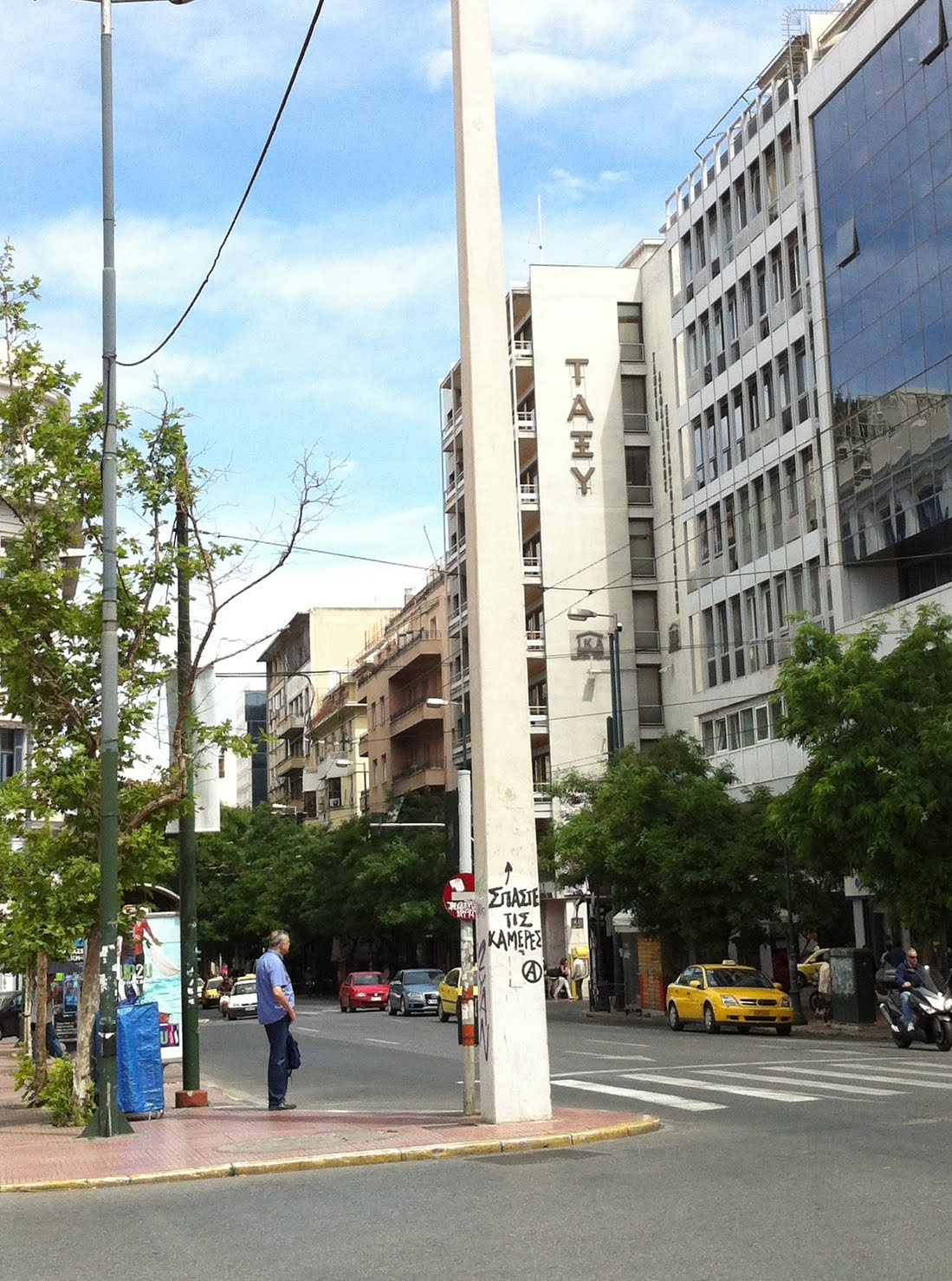
a pole supporting a surveillance camera near downtown's bus terminal with anarchist's writing (with my translation): break the cameras

Τράπεζα της Ελλάδος (Bank of Greece) near Metro station Panepistimio on Eleftheriou Venizelou Street - has no authority to print Euro bills

a statue commemorating the end of using the Greek Drahma - showing a drahma coin (ΔΡΑΧΜΗ)

a close-up of the lower part of the statue with fine print saying (with my translation): Drahma, the oldest currency in Europe stopped (circulation), and replaced by Euro on January 1, 2002

Greek traditional dance being demonstrated during a Greek festival in Munich June 27, 2010

I am happy to see the Greek traditional costume demonstrated at the same event because I haven't had a chance to shoot such a nice traditional dress here in Greece

Greek fast food being served

Greek fast food menu in German
My boy's playmate's father, a US-educated aerospace engineer, has been working in Germany for years, a family involuntarily separated by the reality of lack of work opportunity (and of people connection) here in Greece. When his landlord decided to take his rental apartment for own use recently after many years of living in the same apartment, it took him a long time to locate a new apartment because Greeks are no longer welcome in Germany although he works there and contributes to the German GDP.
When the Olympic Airline privatized a few years ago, his resume for applying for a lower-paying job in Greece (so he can be with his family) had gone unanswered probably due to his lack of connection in Greece.
Whereas a freind of my husband - a computer professor who had earned enough money abroad and had decided to return (about 5+ years ago) to contribute his expertise to teaching his beloved country's students may have started to question his wrong decision.
Other Greeks overseas may feel "no pride being a Greek", or have to conceal his identity for safety reasons.

The people of Greece are pushed to this stage where they have to pick between an experienced party that had participated in this country's most famous national sport - corruption, which was initiated by the PASOK, or an inexperienced SYRIZA who knows nothing about governing, but very experienced in rioting.
Alternatively, the politicians in Greece can set aside their differences and rebuild their bankrupt country through cooperations.
God bless Greece!
Wednesday, April 4, 2012
Some facts about Greek olive oil
Friends who
have visited me from Taiwan or North America always say to me that the extra
virgin olive oil we have in Greece smells really good, and after they sample
the olive oil with bread or vegetables, they tell me that my olive oil tastes
so good and not just smells good.
In fact Greek
olive oil is awesome but little known. Read the rest of this post and find out
why.
That’s right,
real extra virgin olive oil smells good, but the imported “extra virgin” olive
oils my visiting friends buy from their hometown supermarkets do not smell the
same. Well, the truth is that if it does
not smell good, it is probably blended with other types of oils or it is rancid
but is being sold as fresh extra virgin olive oil.
My blogger
friend, TaTsou, recently has been approached
by some olive farmers in Sitia, Crete who are seeking his
help in promoting premium quality olive oil abroad. TaTsou had served his community service in
lieu of military service in nearby town in Crete. He contacted me since I am also interested in
promoting Greek olive oil and especially after my own previous bad experience
of buying a bottle of so called Italian made “extra virgin” olive oil in a N.
American supermarket, after opening up the bottle the oil had a strange
smell. I feel compelled to share some
knowledge with readers about olive oil and especially the goodness of the Greek
olive oil. I am contemplating on
starting a separate blog that will cover various topics that are centered on
olive oil.
 |
| olive field in North Kynouria Βόρεια Κυνουρία |
I remember
seeing TV news of Greek farmers dumping produce on highways, but didn’t
understand what could have triggered such protests that could cause highway
congestions and public discontent.
The “potato
revolution” started from late February in northern Greece (the story was blogged
about here by the Tails
of Athens, and reported
here by the
Guardian), and after reading the details of the stories, I just realized that:
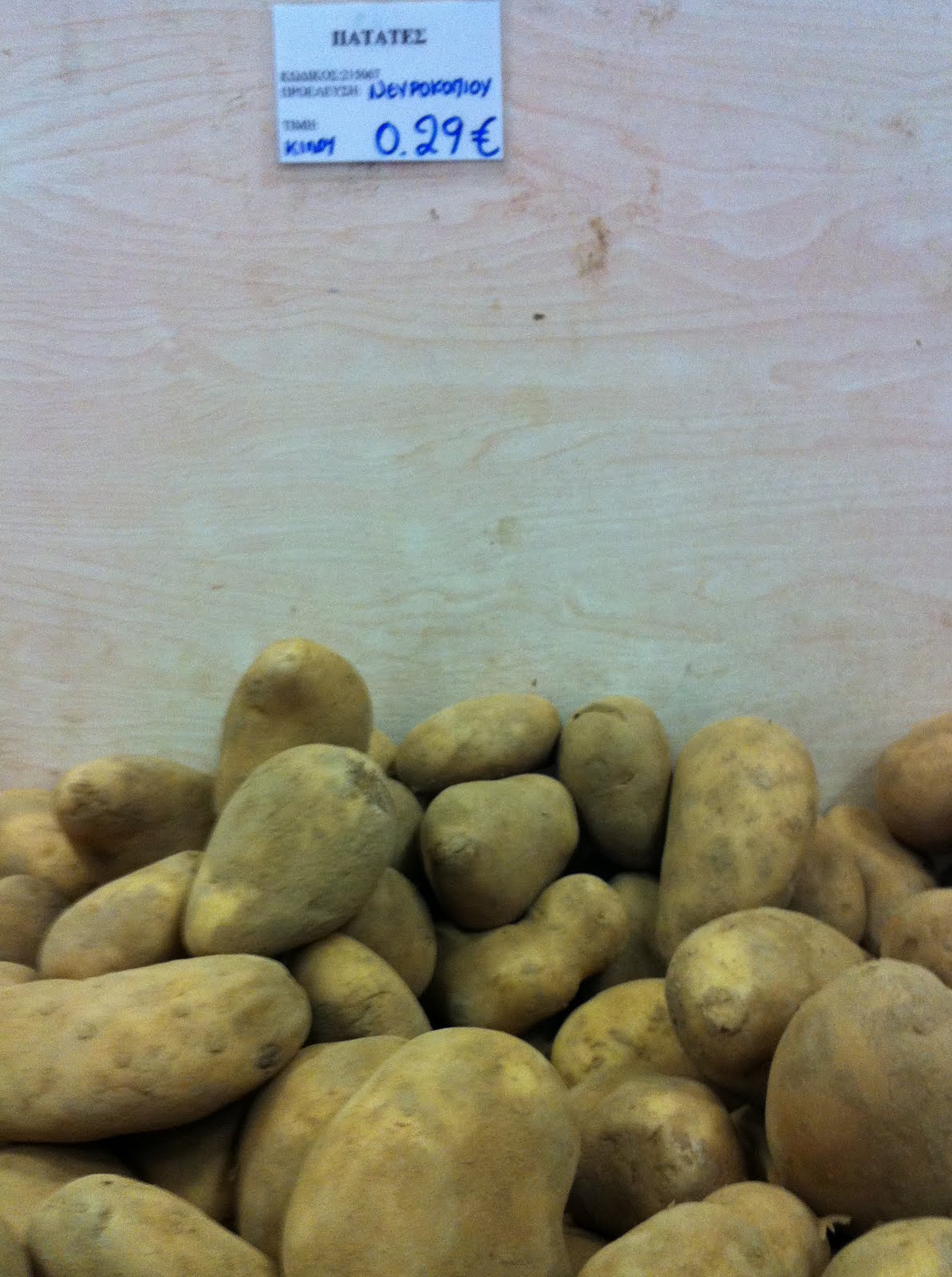
It costs Greek potato farmers about 20 Euro cents to produce one kilogram of
potatoes, but the wholesale middlemen buy them for not more than 15 Euro cents
per kilogram and get the crop to supermarkets where potatoes are sold for at
least 65 Euro cents per kilogram, so for decades the middlemen are the winners
but both consumers and farmers are the losers.
I feel it is
the right thing to do to help the Greek olive farmers since it will benefit
both consumers as well as olive farmers.
 |
| olive flowers can be seen in late spring |
My knowledge is
that this year, if I were to sell my excess olive oil (oil that I don’t need to
keep for my own family consumption) to the oil processing plant, I will be paid
only 2 Euro per kilogram by the processing plant, this is much less than it
costs me to produce the oil, namely expenses incurred for fertilizers, branch
trimming, maintenance of fields, and olive collection labor, oil extraction
fees. The oil processing plant in turn will
sell the oil to those packing companies which are large and famous, but they
mix up olive oils from different sources, despite this they can mark-up the
price and make huge profits. So it makes
sense to keep my excess oil to give as gifts to other families and friends who
have no olive farms or are in economic crisis due to austerity measures.
For small scale oil producers this fact (making no profits) does not matter so much
economically, but for the full-time farmers with many olive trees, they may suffer losses after counting so many
kilograms of olive oil.
Greece has by
far the largest per capita consumption of olive oil worldwide, over 26 liters
per person per year; Spain and Italy, around 14 (from http://en.m.wikipedia.org/wiki/Olive_oil under the subtitle
"global consumption"), and because Greeks consume so much olive oil
per person, it follows that they want to produce the best olive oil for
themselves. It is very logical that one
would want to make the best product for his own consumption, as it turns out
Greece has the “highest percentage” of extra virgin olive oil production in the
world, about 80% of olive oil produced in Greece is extra virgin, but with such
high quality production, the quantity is compromised, and this is one of the reasons
why Greece does not have the largest tons of olive oil output, another reason I
believe is related to demand and marketing, if Greeks don’t know where to sell
their good olive oil, why should they produce more?


What is the definition of extra virgin olive oil?
Before
defining “extra virgin olive oil”, one must first understand the definition of
“virgin olive oil”.
“Virgin olive
oil” is the oil obtained from the fruit of the olive tree solely by mechanical
or other physical means under conditions, particularly thermal conditions, that
do not lead to alterations in the oil, and which have not undergone any
treatment other than washing, decantation, centrifugation and filtration. The acidity of virgin olive oil is less than
2%.
“Extra virgin
olive oil” comes from virgin olive oil and contains no more than 0.8% acidity;
extra virgin olive oil has a superior taste.
I have my own
olive farms in 3 different places and last harvest season (winter 2010-2011) we had
olives crushed and processed at 40 degree Celsius to produce our olive oil, but
this season (winter 2011-2012) we cold-pressed our olives and were able to produce olive oil within 0.25% acidity (much lower
acidity than the 0.8% defined by the IOC i.e. International Olive Council), so
I guess it could be called “superior extra virgin olive oil” but the output was
compromised, the benefit though is that the oil smells and tastes really
fantastic.

Extra virgin
olive oil accounts for less than 10% of oil in many producing countries; but the
percentage is far higher in the Mediterranean countries with Greece: about 80%
of olive oil produced is extra virgin, Italy: about 45%, and Spain: about
30%. If Greece were to produce less
percentage of extra virgin olive oil, the total output of olive oil production
will be increased. Besides, many Greek
farms are unattended for, so full production potential has not been
reached. But now with the unemployment
rate for young people in Greece being nearly 50%, I assume many young people
will go back to till the land and start rural life.
Definition of lower-grade olive oils
For olive oil
classification of lower-grade types, which most Greeks have little knowledge
about since they produce high-end quality olive oil, please go to the link
below, it is an official document link to the olive oil classification by the
IOC:
http://www.foodlabellingreview.gov.au/internet/foodlabelling/submissions.nsf/lookupSubmissionAttachments/1ATAN-85Z33Y20100601105421ASKW/$FILE/655a.pdf
http://www.foodlabellingreview.gov.au/internet/foodlabelling/submissions.nsf/lookupSubmissionAttachments/1ATAN-85Z33Y20100601105421ASKW/$FILE/655a.pdf
What
is the definition of “first cold pressing”?
Referring to the Reference area at the end of this post,
here is the excerpt from the EU document:
(a) the
indication "first cold pressing" may appear only for virgin or extra
virgin olive oils obtained at a temperature below 27 °C from a first mechanical
pressing of the olive paste by a traditional extraction system using hydraulic
presses;
(b) the indication "cold extraction" may appear
only for virgin or extra virgin olive oils obtained at a temperature below 27
°C by percolation or centrifugation of the olive paste
The
health benefits of olive oil
This Mayo clinic link
explains some of the health benefits of olive oil http://www.mayoclinic.com/health/food-and-nutrition/AN01037
The main type of fat found in all kinds of olive oil is monounsaturated fatty acids (MUFAs). MUFAs are actually considered a healthy dietary fat. If your diet emphasizes unsaturated fats, such as MUFAs and polyunsaturated fats (PUFAs), instead of saturated fats and trans-fats, you may gain certain health benefits.
MUFAs and PUFAs may help lower your risk of heart disease by improving related risk factors. For instance, MUFAs may lower your total cholesterol and low-density lipoprotein cholesterol levels. MUFAs may also help normalize blood clotting.
 |
| healthy diet includes using olive oil instead of butter in spaghetti |
How
to use olive oil in cooking
When I first came to Greece,
I was still used to stir-fry vegetables (and sometimes meat too) by using other
types of oils, and was using olive oil occasionally for salad and dipping
bread. Back then my in-laws were
wondering why I was buying other types of oils from supermarkets when we
ourselves have over-supply of good quality olive oil.
 |
| feta cheese with olive oil |
After learning the potential
health concerns related to high temperature cooking in frying pans, I started
to fast-boil vegetables (heating water to its boiling point and dumping in
vegetables to cook for a short time) then after removing water just add salt
and olive oil for taste, sometimes chopped-up garlic are also added for more
intense taste. I also boil spaghettini /
capellini and after removing water my kids really love to eat them with the
combination of extra virgin olive oil and Kikkoman soy sauce (not advertising
for this brand but this is the only good soy sauce imported that I can find in
Greek supermarkets).
Greek people leave their vegetables
(such as cauliflower or broccoli) boiling for too long, after removing water
they add salt, lemon juice, and olive oil for taste, but I think for best
nutritional values, the boiling time should be reduced.
For Taiwanese, they should
re-think whether traditional stir-frying is a healthy way of cooking, maybe
they can reduce stir-frying frequencies and sometimes use fast-boiling cooking
method. If you still insist on high
temperature stir-frying or deep-frying, then blended lower grade olive oil or
other types of oils are more suitable for your purpose because extra virgin
olive oil loses its nutritional values and burns more easily on high
temperature cooking.
 |
| boiled beetroots with olive oil & vinegar, garlic mashed potatoe |
Finding
alternative transportation means for olive oil
I hope the future Greek
government or some private competitors to the ELTA Hellenic Post will soon provide
in-expensive shipment, efficient transportation means to boost our olive oil
export potential.
Olive
oil is liquid gold
Everyone knows what solid
gold is, but not everyone knows what liquid gold is, well olive oil was called “liquid
gold” by ancient Greek poet Homer.
Considering the main color
of olive oil (some are golden while others may be greenish) and more
importantly the health benefits of it, indeed Homer was right!
Thinking
of buying direct from farmers?
Different region and
different variety of olive trees may give slightly different taste of olive
oil. So I do not recommend one over the
other as taste is always depended on personal preference As a matter of fact, I like to try different olive
oils produced from various trees and from different regions, so sometimes I
swap my oils with friends.
 |
| TaTsou's farmer friend's "mountain" brand olive oils |
For general enquiry of
TaTsou’s farmer friend’s olive oil, write to this address lasithi.olive.oil AT gmail.com
For the location of Sitia
(The island of Crete is located on the lowest part of the map, and Sitia is on
the most eastern part of Crete) see this link:

For general enquiry of my olive oil, which will be
commercialized in the near future, write to this address oliveoilftt AT gmail.com.
 |
| my olive oils in a gift box |
For more olive photos, click here.
References:
1. Article 5 (a) in the text of this EU document (EUR-Lex-32002R1019)
defines the labeling standard for “first cold pressing”
Monday, June 6, 2011
EU to impose aviation CO2 emission tax and some links

The EU will impose air passenger CO2 emission tax starting 2012, I suppose it will include small private jets often used by multimillionaires as long as they use "regular" airports for landing, but what if their pilots have expertise to land on a "makeshift" runway to avoid paying tax? I guess they will end up in police custody or in a hospital. How about those diplomats, head of state, UN workers, parliamentarians who often use jets as transportation means more often than us, make sure they are not exempt, they should pay as well as tourists. How about the poor expatriates like me who need to visit relatives back home from time to time? I will just have to pay more for airline tickets...
Aviation CO2 emission has increased in EU, with statistics by airlines, airports, and countries here.
My Romanian friend told me that some 15 - 20 years ago, the poor migration workers used to walk from their villages in Romania to reach Greece by foot carrying with them a spare pair of running shoes, they walked until the original shoes were torn and they replaced it with the spare one. These migration workers walked and did not contribute to global warming, so as a rule of thumb, the citizens of richer countries are likely to contribute more to global warming, it is fine to tax CO2 aviation emission tax as long as it is applied fairly across the board, but I think no matter how expensive the tax is to be added to air ticket, multimillionaires can afford to pay, and I doubt their air travel will be reduced.
So the aviation emission debate will continue...
Some links:
Subscribe to:
Posts (Atom)